

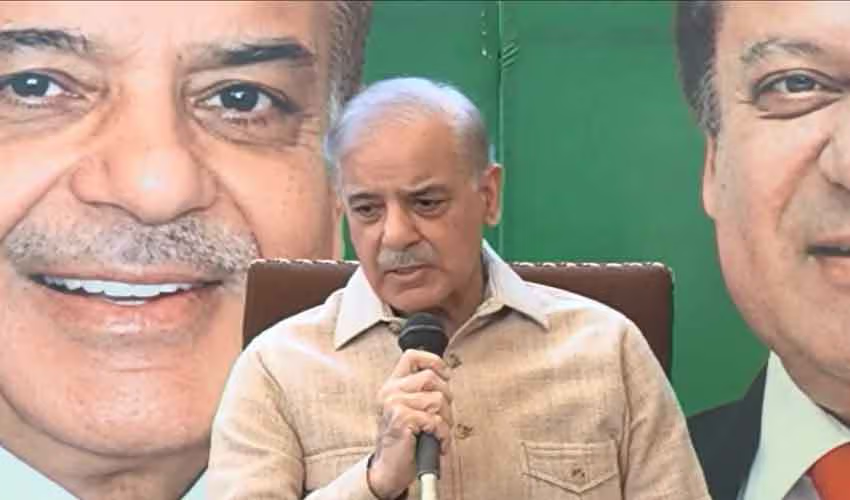
Prime Minister Shehbaz Sharif has defended the government’s decision to impose Governor’s Rule and declare an emergency in Khyber Pakhtunkhwa, stating that the move became necessary to avert bloodshed after repeated efforts to settle differences with the former chief minister proved unsuccessful.
Addressing the media in Gujranwala, the prime minister accused Pakistan Tehreek-e-Insaf (PTI) of proceeding with its planned long march despite ongoing negotiations. He warned that the government could not simply stand by while security threats continued to grow.
Explaining the decision, Shehbaz said he had repeatedly appealed to the former KP chief minister to reconsider his stance and had made substantial efforts to highlight the province’s deteriorating situation.
“I tried hard to reason with the former chief minister; the step to declare an emergency was taken out of necessity,” the prime minister said, stressing that the government had no choice but to act in the broader interest of Pakistan.
He further said that PTI had a history of protests escalating into violence and alleged that preparations were once again underway for widespread bloodshed.
“We could not remain silent spectators,” Shehbaz said, maintaining that inaction could have prompted future generations to question why the government had failed to respond.
Several Meetings Held with Former KP Chief Minister
Shehbaz said he had held several meetings with the outgoing chief minister to review the situation in Khyber Pakhtunkhwa and discuss possible measures to tackle the province’s security issues.
He said he had urged the former chief minister to recognise the importance of KP as a beautiful province and assured him that the federal government was willing to work for the welfare of its people.
The prime minister added that he had proposed a joint strategy to combat terrorism and promised to provide all the resources required to strengthen counterterrorism efforts.
“Regrettably, despite all our efforts, our soldiers and officers have sacrificed their lives,” he said, highlighting the ongoing human toll of terrorism.
Long March Deal Falls Through
The prime minister stated that the federal government had established a committee and engaged in continuous negotiations around the clock to settle the dispute through peaceful means.
Shehbaz said the talks were held in good faith with the aim of reaching a mutually acceptable solution, and a draft agreement had also been prepared.
He explained that the negotiations had resulted in an understanding that PTI would call off its planned long march. However, the party asked for the proposed agreement to be forwarded to the chief minister.
According to Shehbaz, despite the understanding reached during the discussions, the situation shifted towards preparations for a long march and the issuance of threats rather than cooperation.
He also expressed criticism over the appointment of individuals he described as non-political members of the Khyber Pakhtunkhwa committee, arguing that the process had not achieved its intended objectives.
Shehbaz Sharif said Pakistan’s history of long marches and sit-ins raised serious concerns, pointing to a protest held last year that, according to him, descended into violence.
He alleged that another plan had been prepared that could have triggered widespread bloodshed, a development he cited to justify the government’s decision to intervene.
The prime minister argued that repeated announcements of a long march and ongoing threats had left the government with little choice but to take action rather than remain a bystander.
He said the imposition of Governor’s Rule and the declaration of a state of emergency were decisions made in Pakistan’s best interest, adding that he was optimistic the measures would deliver positive outcomes.
PM Highlights Economic Gains and Public Relief Initiatives
The prime minister also highlighted what he described as an improvement in the country’s economic situation, stating that Pakistan’s global standing was strengthening due to the efforts of its political and military leadership.
He said the economy was gradually showing signs of recovery and pointed to fuel subsidies as an example of measures introduced by the government to provide relief to the public.
According to Shehbaz, around 12 million people were receiving benefits through fuel subsidies, while 65 million people were benefiting from reduced petrol prices.
He described these measures as part of the wider national interest that, he maintained, had remained central to the government’s decision-making.
Shehbaz Sharif Plans Visit to Khyber Pakhtunkhwa
The prime minister announced that he would travel to Khyber Pakhtunkhwa in the near future, indicating that the province remained a priority for the government.
He said he had repeatedly urged the former chief minister to work alongside the federal government on security-related issues. However, he maintained that imposing Governor’s Rule had become necessary under the circumstances.
Shehbaz also revealed that his visit was intended to offer condolences on the passing of his colleague, Mahmood Bashir Virk, whose death he described as a significant loss.
Paying tribute to Virk, the prime minister praised his compassionate nature and said his contributions to politics would be remembered for years to come.