


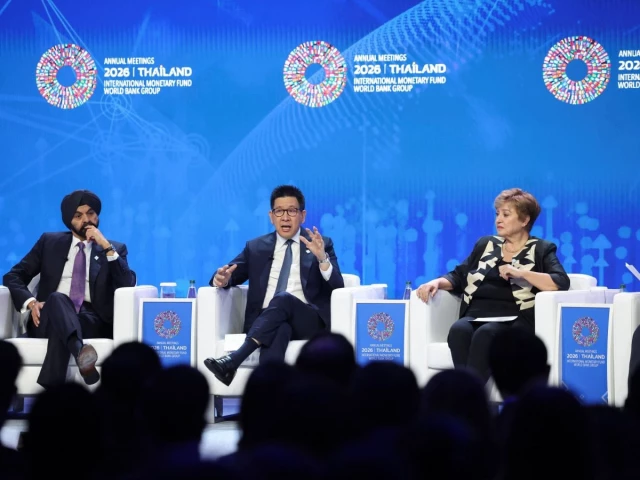
The International Monetary Fund (IMF) warned on Tuesday that the possible end of the artificial intelligence (AI) investment boom, rising debt burdens, and a prolonged conflict in the Middle East could pose serious threats to global economic growth and financial stability.
The IMF projected global economic growth at 3.1% for 2026, slightly higher than its July forecast of 3.0%. Continued strong investment in AI infrastructure is expected to help counterbalance the impact of rising oil prices triggered by the Middle East war.
In its latest World Economic Outlook report, released in Bangkok during the annual meetings of the IMF and the World Bank, the fund also projected global growth of 3.4% in 2027. However, this outlook depends on the Strait of Hormuz reopening by March and shipping conditions returning to their pre-war levels by October 2027.
The IMF cautioned that a longer-lasting conflict, which keeps oil prices above $130 throughout the first quarter of 2027, could reduce economic growth next year by half a percentage point.
AI Adjustment
In a separate downside scenario, the IMF warned that a significant decline in AI investment could trigger a sharp sell-off in asset markets, eventually reducing global GDP by 1.1% by 2028. US economic output could fall by 1.8% under this scenario.
“We now have an economy that is standing on one leg, the AI leg,” IMF Managing Director Kristalina Georgieva told a Bretton Woods Committee event. “What if it wobbles? What if there is disappointment and that leads to potentially a more difficult environment?”
The IMF raised similar concerns in its separate Global Financial Stability Report, cautioning policymakers against “complacency” when addressing the possibility of declining AI investment and falling stock valuations.
“If there are questions about the monetisation of AI, the equity investments will deplete in value, the debt may be difficult to service, and the revenue commitments in the future may not materialise,” Jason Wu, assistant director of the IMF’s Global Markets Analysis Division, told a press conference during the Bangkok meetings.
Athanasios Vamvakidis, deputy director of the IMF’s Monetary and Capital Markets Department, said a correction in the AI market could affect the wider economy, putting downward pressure on asset prices and weakening overall demand as declining wealth influences spending.
The downturn could also slow international trade, according to IMF chief economist Silvana Tenreyro. Trade in AI-related goods expanded by 29% between 2023 and 2025, more than three times the 8.3% growth recorded in global trade over the same period. Tenreyro said that without trade in AI goods, overall trade growth would have reached just 4.6%.
Another concern raised during the Bangkok meetings was the growing cybersecurity risk associated with AI. These warnings come as banking regulators intensify their efforts to manage AI-related threats. Reuters has reported that major US regulators are questioning banks about their use of advanced AI models, while European regulators are urging financial institutions to strengthen their recovery plans.
Recession Remains Unlikely
However, IMF Deputy Research Director Petya Koeva Brooks told Reuters in an interview that even the sharpest decline in economic output under the worst-case AI risk scenario was unlikely to push global growth down to levels associated with a worldwide recession.
Fiscal and Bond Market Challenges
The IMF reports and participants at the meetings also drew attention to the dangers posed by high levels of public debt and rising bond yields. These yields could climb further as war-related inflation intensifies, placing additional pressure on government budgets through higher debt-servicing costs and weakening economic growth.
Georgieva cautioned against complacency among “systemically important” advanced economies that are “negligent about their fiscal position” and are not taking steps to control their debt burdens, despite developing economies having been compelled to do so.
Developing Nations Urged to Reduce Spending Despite War Fallout
The IMF cautioned that low-income developing nations were bearing the unequal burden of the energy crisis triggered by the Iran war. Many of these countries had “no choice” but to reduce public spending or risk having to restructure their debt.
Speaking to AFP on the sidelines of the organisation’s Annual Meetings in Bangkok, Brooks said heavily indebted countries that rely on oil imports were suffering the most from the energy shock. She added that these nations faced tough decisions about how to support their populations during the crisis.
“Unfortunately, after years of the global economy being hit (by) shock after shock, debt levels have increased quite a lot, and at the same time, inflation has become a problem,” she said.
“For those countries that are most vulnerable, this is where the consumption basket is heavily weighted towards energy and food, and so indeed it is much much more difficult,” she added.
Nigerian Finance Minister Taiwo Oyedele, who chairs the Group of 24 developing nations, described debt vulnerabilities across many developing economies as a “major barrier” to inclusive growth. He cautioned that member countries were facing increasingly heavy debt burdens.
Oyedele said estimates indicated that developing nations were paying $500 billion more in debt costs than developed economies, while also struggling with widening budget deficits.
This week, the IMF called on governments to take politically difficult measures to bring public finances under control. The organisation praised Britain as the only major advanced economy to have presented clear plans for reducing government borrowing in the coming years. However, it urged the country to maintain its approach just weeks before the new UK government is due to announce its budget plans.
According to Josh Lipsky, vice president of international economics at the Atlantic Council, who is attending the meetings in Bangkok, few governments are responding to the IMF’s appeals to reduce borrowing.
“France, Germany, and the US all need to do fiscal consolidation, but they’re moving in the opposite direction,” Lipsky said. “I’m afraid that it’s going to take some kind of crisis to wake up and realise that this is what has to be done.”