


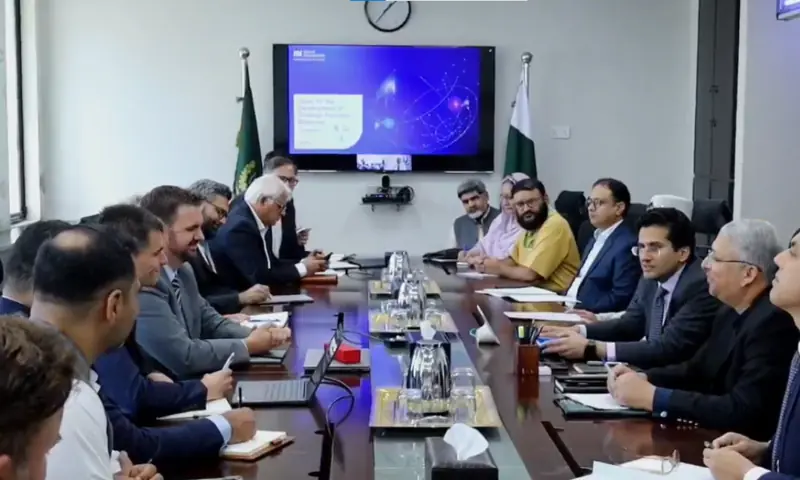
The government on Tuesday started a feasibility study on petroleum reserves (SPR) with the help of international consultancy firm Wood Mackenzie.
Federal Minister for Petroleum Ali Pervaiz Malik today chaired the kick‑off meeting with Wood Mackenzie. Wood Mackenzie was chosen to run the study after a tender that drew four bids.
Wood Mackenzie Vice President Christopher Darry, Director Chris Brown, Principal Consultant Jordan Macdonald and Senior Vice President Aamir Malik were in attendance. Representatives from Attock Refinery Limited, the Pakistan Institute of Development Economics, Government Holdings (Private) Limited, the Ministry of Maritime Affairs and Pakistan LNG Limited also joined the meeting.
The minister was given a briefing on the scope and goals of the study. After that, the meeting set the timelines and design for the assignment. This was stated by an official of the information ministry.
The minister said that the government is working on reforms and actions to strengthen Pakistan’s energy security and that energy security is closely tied to security. The minister said that keeping energy supplies strong and cutting risks from shocks is a top priority for the government.
He said that the recent crisis in the Strait of Hormuz has made it even clearer that Pakistan needs buffers and greater resilience against supply disruptions.
“The SPR initiative is therefore a step towards assessing how Pakistan can strengthen its preparedness for potential supply shocks,” he said. He also noted that the Economic Coordination Committee (ECC) had already approved a “world‑class bonded scheme” for international oil players.
The government on Monday formally approved that foreign fuel suppliers may set up bonded storage facilities in Pakistan at their expense. These facilities can be used for purposes such as re‑export and supplying the local market.
Malik said that the purpose of commissioning the study is to enable the government to make a decision based on evidence before starting such a major strategic initiative.
The minister also emphasised that the study should provide an ” implementable” solution that suits Pakistan’s requirements and helps to determine the most appropriate way forward. This may include the possibility of pursuing SPR development in a phased manner. I believe this phased approach is sensible.
According to the statement, Wood Mackenzie said it is the ” time” for Pakistan to work on energy security, especially given the changing global energy landscape and recent supply disruptions.
Wood Mackenzie said the study will focus on developing a solution based on Pakistan’s specific requirements and circumstances.
“The study will cover feasibility, integrity, safety and operational assessment of proposed strategic storage facilities; international and regional benchmarks; policy and regulatory requirements; and short, medium, and long‑term implementation options,” the statement said. I think the comprehensive approach will help us navigate the challenges.
“It will also examine regulatory, financial, commercial and institutional arrangements, including possible public‑private partnership models.”
The study will assess existing infrastructure that could be used for storage, taking into account connectivity and logistics requirements, the statement noted.
It will also provide “estimates of capital expenditure, financing options, implementation timelines and institutional responsibilities for development of SPR capacity” in Pakistan.
The minister directed all stakeholders to give full cooperation to Wood Mackenzie, ensuring that required data and input are provided on time so that the study can be finished within agreed timelines and “provide a sound basis for future policy decisions”. I am hopeful that the steering committee will keep us updated on progress.
Pakistan has been planning to boost storage for crude oil and refined products to increase its energy security, it emerged in May. With no petroleum reserves, Pakistan has been left exposed to oil supply shocks caused by the US‑Iran war that has choked supplies through the Strait of Hormuz.
In July, Prime Minister Shehbaz Sharif directed authorities to increase Pakistan’s petroleum reserves as a cabinet committee approved amendments to the oil refining policy.