


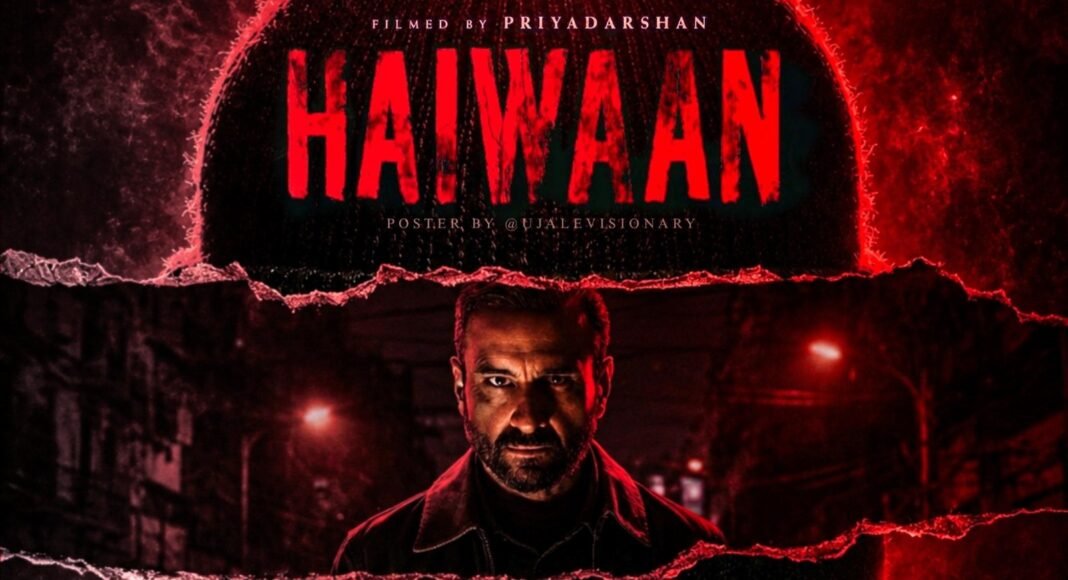
Some films fail to impress audiences despite having star-studded casts, substantial budgets, and intriguing premises. Haivan, starring Akshay Kumar and Saif Ali Khan, proved to be one such film for me. The basic concept is interesting, the director is an experienced filmmaker, and the presence of two leading stars naturally raises expectations. Yet, despite these apparent strengths, the film fails to deliver the suspense, emotional engagement, and narrative coherence one expects from a good thriller.
The most important thing to know about Haivan is that it is not an original story. It is a Hindi remake of Priyadarshan’s own successful Malayalam film Oppam. The problem is not simply that the filmmaker chose to remake his earlier work. Rather, the Hindi adaptation fails to preserve the freshness, realism, and effectiveness of the original—qualities essential to a compelling suspense drama.
In the original film, Mohanlal played a blind lift operator. In the Hindi version, Saif Ali Khan takes on the equivalent central role. The story attempts to build suspense around a dangerous criminal, a retired judge, and a blind man whose extraordinary sensory abilities make him an unlikely opponent for a ruthless adversary.
Interestingly, some of the underlying ideas and suspense elements associated with Oppam can also be traced to earlier thrillers. Critics have drawn comparisons with films such as Cape Fear, Wait Until Dark, and the Hindi film Khilaaf. However, these similarities do not establish that Haivan is a direct copy of all these films.

The Story: An Intriguing Premise That Fails to Deliver
The story revolves around Sham Rane, played by Saif Ali Khan, a blind man who possesses exceptionally developed senses of hearing, smell, and touch. He works as a maintenance manager in a high-rise residential building in Mumbai.
His life takes a dangerous turn when retired Chief Justice Pradhan and his family become entangled with Parshuram Gokhale, played by Akshay Kumar, a ruthless man driven by revenge and a violent past.
As Parshuram pursues people connected to his past, Sham finds himself trying to protect a young girl who has become a target and stop the killer before it is too late.
On paper, this sounds like the foundation of a gripping suspense thriller. But the real question is whether Priyadarshan succeeds in bringing this premise to the screen in a way that preserves its original spirit.
My answer is an unequivocal no.
A Thriller That Struggles to Keep Its Audience Invested
For me, the film’s biggest weakness is that it constantly feeds the audience information without drawing them emotionally into the story.
In a suspense thriller, it is not enough to reveal who the killer is or who might become the next victim. The real achievement lies in making viewers genuinely anxious about the characters’ safety, keeping them on edge and making every new development feel consequential.
Unfortunately, Haivan rarely manages to create that level of emotional investment.
With a runtime of approximately two hours and 45 minutes, the film feels unnecessarily stretched. Several sequences could have been shortened or handled more effectively without sacrificing the central narrative.
The songs make matters worse. Rather than sustaining the tension, they interrupt the narrative flow and weaken the atmosphere of suspense. Various subplots and supporting characters also distract from the central conflict.
In several scenes, the film begins explaining the danger through dialogue and background music before the situation has had a chance to generate any genuine tension on its own.
Every scene in a successful thriller should contribute something meaningful to the story, whether by revealing a character’s psychology, escalating the danger, or introducing a significant clue. In Haivan, this narrative connection is far from consistent.
Saif Ali Khan: A Problem of Characterisation Rather Than Talent
Saif Ali Khan is an experienced actor, but his casting and portrayal in this film raise questions.
His character is not merely a blind man navigating everyday life. He possesses extraordinary abilities that allow him to overcome seemingly impossible challenges. The problem is not that the character is exceptionally capable; it is how those abilities are presented.
At times, Sham appears capable of solving extraordinarily complicated problems through his hearing and other senses alone, almost as though he possesses an answer to every challenge the story throws at him.
There is an important distinction between portraying a blind person with remarkable abilities and turning that person into someone who can seemingly overcome every obstacle without difficulty. Haivan fails to establish that distinction convincingly.
In the Malayalam original, Mohanlal’s performance and the comparatively grounded atmosphere made the character feel more believable. His portrayal gave the protagonist a greater sense of authenticity, even when the story placed him in extraordinary circumstances.
In my opinion, the problem lies less with Saif’s acting than with the writing and direction. Had the film established a better balance between the character’s physical abilities, limitations, vulnerabilities, and the dangers he faces, audiences might have developed a much stronger connection with him.
Akshay Kumar: A Villain Who Fails to Inspire Fear
Parshuram offers Akshay Kumar an opportunity to move beyond his familiar heroic image and explore a darker character. The role contains elements of revenge, violence, and psychological instability.
However, an effective villain requires more than a menacing expression or displays of anger.
A truly frightening antagonist can unsettle the audience through silence, unpredictable decisions, calculated behaviour, and psychological pressure. The most disturbing villains are often those whose next move remains impossible to anticipate.
In Haivan, Akshay’s performance occasionally feels so exaggerated that, instead of creating fear, it unintentionally borders on comedy.
This becomes particularly damaging during the film’s final confrontation, where the intensity of the conflict should reach its peak. When a villain fails to generate a convincing sense of menace, the climax inevitably loses some of its impact.
Priyadarshan’s Conflicting Tones
Priyadarshan is one of my favourite directors, which makes my disappointment with Haivan even greater.
The central problem is that the film’s serious crime-thriller elements, unnecessary comic moments, and conventional Bollywood treatment never quite come together.
Just when the story should be generating fear, a comedic sequence appears. When the suspense should be intensifying, the narrative seems to lose momentum. The result is an inconsistent atmosphere that prevents the film from establishing a compelling identity of its own.
Comedy can certainly coexist with suspense, and Priyadarshan has demonstrated considerable skill in handling comedy throughout his career. But tonal shifts need to feel deliberate and organically connected to the story.
Here, they frequently undermine the tension rather than enrich the experience.

Oppam Versus Haivan: What Went Wrong?
The fundamental challenge for the Hindi remake was to do more than retell the original story. It needed to reinterpret the material effectively for a new audience while preserving the elements that made Oppam compelling in the first place.
Instead, the remake retains many of the original’s narrative developments and shortcomings without offering a sufficiently distinctive perspective or a meaningful improvement in execution.
A remake should justify its existence by bringing something new to the table. That might mean deeper characterisation, a tighter screenplay, a more convincing atmosphere, stronger performances, or a fresh approach to suspense.
Unfortunately, Haivan does not provide enough of these improvements to establish an identity separate from its Malayalam predecessor.
For viewers familiar with Oppam, many of the story’s developments may also feel less surprising, further reducing the remake’s ability to sustain suspense.
Technical Aspects: Visually Appealing, Narratively Weak
To be fair, the film is not a complete failure in its technical execution.
The cinematography is visually appealing, and the production design reflects considerable effort. Some of the frames are attractive, and the film has moments of visual polish.
However, beautiful compositions cannot compensate for a weak narrative.
The screenplay needed greater discipline, the background score could have been used more effectively to build tension, and the songs should have been integrated more carefully into the overall structure. The editing also needed to be tighter, particularly given the film’s lengthy runtime.
The climax, in particular, fails to deliver the satisfying payoff that a thriller of this nature requires.
When a film spends so much time building toward a final confrontation, the conclusion should reward the audience’s patience. In Haivan, the weak climax becomes another factor contributing to the overall disappointment.
Final Verdict: A Missed Opportunity
For me, the real problem with Haivan is that it fails to exploit the full potential of a strong underlying premise.
Saif Ali Khan’s character occasionally becomes unrealistically extraordinary. Akshay Kumar, despite playing a supposedly dangerous antagonist, struggles to generate the fear necessary to make the conflict truly compelling. Meanwhile, the excessive runtime prevents the suspense from remaining consistently intense.
The film has an intriguing story, two established stars, and an experienced director behind the camera. Yet these ingredients never come together to create a memorable thriller.
If I had to sum up Haivan in a single sentence, I would describe it as a film that has the story, the stars, and the director—but lacks the narrative grip needed to turn them into a genuinely engaging cinematic experience.
Honestly, Priyadarshan has disappointed me enormously with this film. He has neither elevated the suspense of the original nor given the characters greater depth. More importantly, he has failed to introduce a fresh perspective that would give the Hindi remake a distinct identity of its own.
My recommendation: If you have not watched Oppam yet, I would suggest watching the original Malayalam film first. In my opinion, it is the better choice for anyone looking for a more convincing suspense thriller.
Haivan had the potential to be a compelling remake. Sadly, it ends up being a reminder that revisiting a successful story is not enough. A remake must recreate the original’s emotional impact, preserve its dramatic tension, and offer audiences a reason to experience the story again. On those counts, this film falls disappointingly short.