


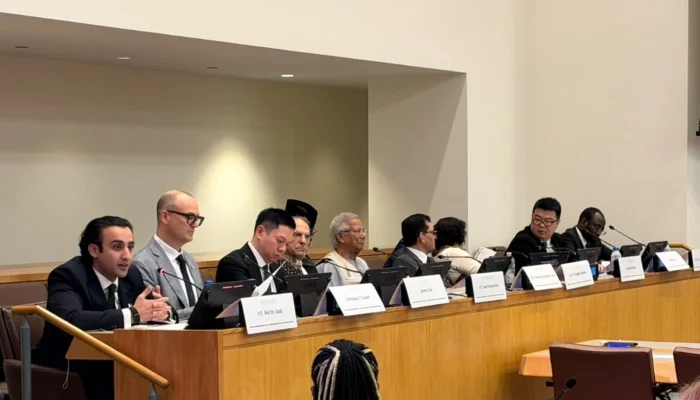
Pakistan Virtual Assets Regulatory Authority (PVARA) Chairman Bilal Bin Saqib has stated that artificial intelligence and tokenisation can become the powerful engines of financial inclusion for the developing world. He stresses that artificial intelligence and tokenisation must be made accessible to people who are excluded from financial systems.
During the Session of the United Nations General Assembly, Bilal Bin Saqib spoke at the Social Business, Youth and Technology Forum. He delivered a keynote that highlighted the choice that emerging economies now face as the rules of finance are being rewritten.
The address put Pakistan’s journey into a story. Around the world, about 1.3 billion adults have no account at any institution while almost 900 million of them already own a mobile phone.
The speaker said the gap is no longer about technology. It is about rails, rules and the willingness to build them.
The forum opened with a high‑level panel that included Dr Khalilur Rahman, President of the UN General Assembly; José Ramos‑Horta, President of Timor‑Leste and Nobel Peace Laureate; Dasho Tshering Tobgay, Prime Minister of Bhutan; Minister Wellington Dias of Brazil; and Nobel Peace Laureate Professor Muhammad Yunus, whose pioneering microcredit work the forum honored.
Pakistan was shown as proof that a choice can be made. In 2018, Pakistan closed its banking system to assets.
With the Virtual Assets Act 2026, that door reopened under a regulatory framework. A regulatory sandbox was then set up. Licensing regulations for virtual asset service providers were launched.
Independent global adoption indices show that more than 40 million Pakistanis use virtual assets. This makes them one of the youngest user groups in the world.
“For long, the Global South has been on the menu. Pakistan has chosen the table with our pen writing our own destiny,” said Saqib. “We do not want to be takers of this technology. We want to be makers of it. Technology alone includes no one. Regulation alone includes no one. Inclusion happens where the two meet.”
The keynote finished with a focus on the generation the forum serves. It called on innovators across the developing world to build without waiting. It framed the goals of zero poverty and zero unemployment as not dreams but as objectives that today’s tools can help design.