


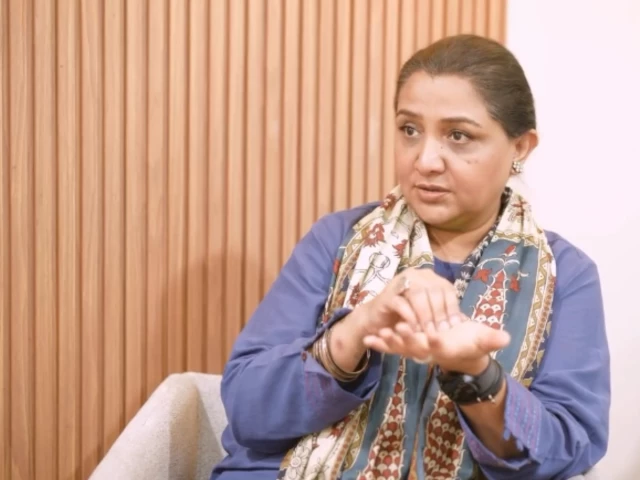
Actor Nadia Afgan contended that Pakistan’s habit of responding to helplessness with violence — regardless of whether the victim is a stray animal, a woman, or a child — originates from one common issue: an absence of accountability.
Speaking about Punjab’s ongoing campaign to cull stray dogs during an interview, Nadia characterized the practice as merely a symptom rather than an actual solution to managing stray animals. She also raised doubts about its legal standing, pointing out that the Lahore High Court had earlier issued rulings against practices like poisoning or shooting stray dogs.
“In 2021, I found out there was a law; the Lahore High Court stated there’s a law that you cannot cull dogs like this, you cannot poison them or shoot them, you cannot treat animals like this. But it is still happening. If the government itself is not abiding by the law, then what will the people do?” she said.
According to Nadia, the core problem isn’t a shortage of laws but rather the failure to properly implement the ones already in place.
“Pakistan doesn’t lack legislation,” she said. “I think there is a complete breakdown of everything here. It is a matter of accountability. It’s not that we don’t have laws; laws exist for everything, some built in 1902, some in 2021.”
She was cautious about framing animal cruelty as a standalone problem. Rather, she positioned it within a broader pattern where individuals and groups holding less power become targets for mistreatment.
“If we talk about abuse, whether it’s inside homes, outside homes, whether it’s animal abuse, abuse against children, women, workers, or any group or religious sect, everything is happening in our country, and it’s happening openly,” she said.
She maintained that mistreatment of animals, women, and children all trace back to the same underlying culture that normalizes violence against those who are least capable of defending themselves.
The discussion further explored the emotional burden of repeatedly encountering such distressing incidents, ranging from acid attacks to the mistreatment of rescue animals.
Nadia talked about the specific sense of helplessness that comes with trying to spread awareness on social media, where important issues often struggle to gain traction against celebrity gossip and online drama.
“You think about what you can do, you post something, and then you start hating yourself thinking, ‘What else am I doing besides this?’ You want to say something for the better, but you are so helpless. It destroys your mental health,” she said.
Nadia mentioned that this emotional toll had, on occasion, pushed her to disconnect from social media entirely.
Another point of frustration she raised was the public’s skepticism toward volunteers and animal shelters.
She dismissed claims that NGOs working in animal rescue misuse the donations they receive, explaining that many such initiatives function on minimal resources and depend heavily on volunteer efforts.
“People say that NGO workers gather money and spend it on themselves, which is complete nonsense; NGOs have no money; young people are selling things from their own homes to do this work. It’s insane,” she said.
Nadia explained that animal rescue work in Pakistan is mostly carried out by volunteers and self-funded individuals, with minimal support from institutions.
She noted that their efforts typically go unnoticed until a video showing animal cruelty gains viral attention, after which public interest quickly moves on to something else.
She further connected the way animals are treated to how children develop their understanding of violence and vulnerability. According to her, normalizing cruelty toward animals can instill in children the belief that violence is an acceptable way to deal with perceived threats.
Nadia said the solution needs to start with positive exposure to animals and fostering empathy, rather than conditioning children through fear. “One myth about street dogs is that you have to fear them,” she added.
She explained her approach to discussing this topic with children — introducing them to animals rather than teaching them to fear them — arguing that empathy is something best absorbed through example rather than direct instruction.
In the end, Nadia positioned the dog-culling debate within a much larger conversation about civic responsibility and the protection of vulnerable groups in society.