


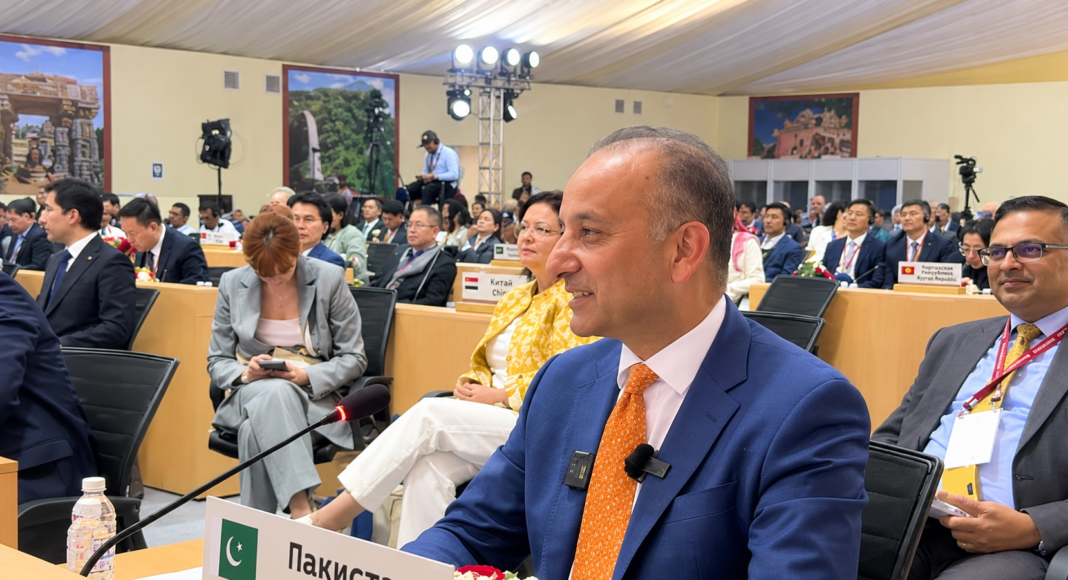
- Musadik Malik Says Pakistan Took Every Possible Step to Promote Regional Stability
- Speaking in New Delhi, the minister highlights multiple sources of regional instability.
- Climate minister urges greater dialogue through the SCO platform.
Federal Minister for Climate Change and Environmental Coordination Dr Musadik Malik on Saturday described climate change as a serious danger to human civilisation and its historical heritage.
“Climate change has become a major threat to our civilisation and historical heritage,” Malik stated while speaking at the Shanghai Cooperation Organisation (SCO) Civilisational Dialogue Forum in New Delhi, India.
The minister reached New Delhi on Friday to participate in the forum, becoming the first Pakistani federal minister to visit India since May 2023. At that time, then Foreign Minister Bilawal Bhutto-Zardari travelled to Goa to attend a meeting of the SCO Council of Foreign Ministers.
Addressing the gathering, Malik said Pakistan was home to three significant periods of civilisation, representing the country’s rich and diverse historical and cultural heritage.
Speaking about Delhi’s Old Fort, the climate minister described the monument as a historical record in its own right. He noted that Mughal ruler Humayun, who originated from Central Asia, had established its foundations.
He further discussed the fort’s historical importance, pointing out that both Humayun and his opponent Sher Shah Suri had left their mark on its history despite being rivals.
Highlighting Pakistan’s historical and cultural connections, Malik explained that the country’s links extended north towards Bukhara and Samarkand, while its cultural ties stretched west towards Persia and Arabia.
Before delivering his speech, Malik also conducted separate meetings with representatives from Iran and Tajikistan on the sidelines of the SCO forum.
On the second day of the event, he met Mohammad Mahdi Imanipour, President of Iran’s Islamic Culture and Relations Organisation. During the meeting, Malik highlighted the longstanding historical and cultural relationship between Pakistan and Iran, according to a statement issued by the Pakistan High Commission in India.
The statement further noted that Malik reaffirmed Pakistan’s strong resolve to strengthen and broaden these friendly relations across various sectors.
The climate minister also met Tajikistan’s Minister of Culture, Sattoriyon Amonzoda, in a bilateral meeting, reaffirming Pakistan’s commitment to strengthening its diverse areas of cooperation with the country, particularly by promoting people-to-people interactions.
During the discussion, Malik also presented several proposals, including the idea of establishing a Virtual Green University to encourage collaboration in climate culture and research.
Malik told reporters that the region was facing several sources of instability and voiced hope that bringing countries together for discussions would contribute to improving the situation.
He said Pakistan would back all initiatives aimed at fostering regional peace and stability, adding that Islamabad had made every possible effort to contribute towards achieving stability in the region.
“Whoever makes efforts to advance peace and security, we will stand with them,” he said.
According to the Pakistan High Commission in India, the minister reached New Delhi on Friday to head Pakistan’s delegation at the forum.
Discussions at the forum will centre on the common civilisational heritage and cultural connections shared by member states, with particular emphasis on preserving regional heritage and enhancing cultural cooperation.
Malik’s arrival in India sparked widespread criticism from Congress spokesperson Supriya Shrinate, party leaders Surendra Rajput and Pramod Tiwari, Samajwadi Party’s Fakhrul Hasan Chand, and NCP (SP)’s Clyde Crasto, The News reported.
They criticised the BJP-led government, accusing it of adopting an inconsistent stance and applying “double standards” by inviting Pakistan. However, the Indian government firmly defended Malik’s presence, stating that he had come to New Delhi at its invitation.
Explaining the reasons behind Malik’s visit, an Indian official said invitations had been issued to all SCO member countries in line with established multilateral practices. India had initially invited Pakistan’s heritage minister, but Islamabad later nominated Malik instead.
When questioned about India’s concerns regarding cross-border terrorism, Malik replied, “I think tomorrow, once I give my statement, we’ll have a lot of conversations…”
Responding to a question about the civilisational connections between India and Pakistan, he said, “I think dialogues are between distinct entities. Singularity doesn’t require a dialogue. Singularity only requires a monologue. Dialogue is about diversity. I think between India, Pakistan, Russia, China and Central Asian states, if you go to the excavations, you would find that dialogue taking place just in the fore. I think it’s a very welcome dialogue.”
Addressing the gathering in Delhi, the climate minister also emphasised the need to expand dialogue through the SCO platform.
“We are having a dialogue across civilisations and cultures. I think we need more and more such engagements. Dialogue across civilisations is particularly important at a time when the entire region is undergoing changes and geopolitics are in flux. It is a very welcome development,” he said.