


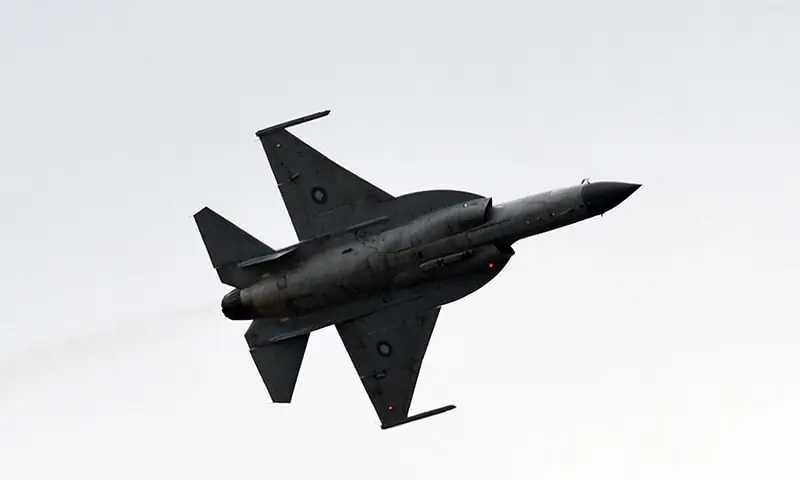
Pakistan carried out airstrikes on sites in the border region with Afghanistan killing more than 28 terrorists the information ministry said on Monday.
In a statement the ministry said the strikes were carefully planned and carried out against the hideouts and safe havens of organizations responsible for recent attacks in Khyber Pakhtunkhwa.
Based on intelligence, targeted attacks on terrorist camps and hideouts linked to Fitna al Khawarij and its affiliates were also carried out in the border region with Afghanistan, the statement said.
It further stated: “Three targets were destroyed with precision, including a suicide bombers’ training markaz (centre), killing 28 terrorists alongside multiple suicide bombers.
“Large quantities of weapons and ammunition stored at these marakiz (centres) and hideouts were also destroyed.”
The state refers to the banned Tehreek-i-Taliban Pakistan (TTP) as Fitna al Khawarij.
Before the airstrikes, security forces carried out a “well-planned intelligence-based ground operation” on Sunday targeting a group of terrorists in the Kohat and Hangu districts of Khyber Pakhtunkhwa, according to the ministry.
“As a result of precise and skilful engagement, nine khawarij belonging to Indian proxy Fitna al Khawarij were sent to hell, while several were injured,” the statement added.
The ministry reiterated Pakistan’s commitment to “always striving for the maintenance of peace and stability in the region”.
“However, the safety and security of our citizens remains our foremost priority. It is a matter of grave concern that Afghanistan continues to remain a hub of terrorism,” it said, specifying that the “threat to Pakistan emanates from Afghanistan”.
“In this context, our action precisely targeted the terrorist hubs. Maximum precautions were taken, and it was ensured that no collateral damage occurred,” the ministry asserted.
The airstrikes were carried out days after a major attack at the old Police Lines in KP’s Kohat, where 23 people were killed, and around 100 others sustained injuries. Eight terrorists were eliminated during an overnight clearance operation conducted to secure the area.
Information Minister Attaullah Tarar visited Kohat on Monday and went to the residence of a police official who was martyred in the attack, according to state broadcaster Radio Pakistan.
During his interaction with the media in Kohat, Tarar said he had also visited injured personnel receiving treatment at the Combined Military Hospital.
He said he remained hopeful that terrorism would eventually be eliminated from the country after meeting the families of the martyrs and ghazis.
“We will not rest until we eradicate terrorism from its roots,” he asserted.
Terrorist activity in Pakistan has increased again since the Afghan Taliban returned to power in Kabul in 2021.
On Sunday, two officers and four other people were killed, while eight terrorists were killed during a fight involving a group of security forces and armed enemies, the military media group reported.
Islamabad has kept asking the Taliban government in Kabul to remove places where terrorists hide in Afghanistan, those connected to the banned TTP, which are used to attack Pakistan. Officials say these requests have not been listened to.
According to a report required by the UN Security Council. Covering the time from December 16, 2025 to June 9, 2026. The Afghan Taliban’s continued help for TTP has led to terrorist attacks in Pakistan, and these attacks have become more deadly even though Kabul has started to take some steps to control the group.
The report also said there are connections between the TTP, Al Qaeda, Islamic State-Khorasan (ISIL-K), and the Baloch Liberation Army (BLA).
‘Ghazab lil Haq’ was launched under the vision of Azm-i-Istehkam
In a statement issued on Monday, the information ministry reiterated that the “relentless counterterrorism campaign Ghazab lil Haq under vision ‘Azm-i-Istehkam’ by security forces and law enforcement agencies of Pakistan will continue at full pace to wipe out the menace of foreign-sponsored and -supported terrorism from the country”.
Pakistan launched Operation Ghazab lil Haq on the night of February 26 after the Afghan Taliban carried out unprovoked firing from across the border, targeting terrorist hideouts in response.
Pakistan’s previous strikes in the border areas of Afghanistan took place in late June. The government said the action was carried out in response to a series of terrorist attacks, including an assault on a Rangers camp in Karachi.
Information Minister Attaullah Tarar said those strikes killed 25 terrorists in Afghanistan’s Paktia, Paktika and Kunar provinces.
Earlier that month, Pakistan had also conducted similar attacks on terrorist hideouts near the Afghan border, with 26 terrorists reportedly killed.
In July, security sources said Pakistani security forces responded to unprovoked firing by the Afghan Taliban targeting border posts in Kurram.
This month the Foreign Office said that real progress in relations with Kabul would only happen if the Taliban took clear and measurable steps against TTP and other terrorist groups based in Afghanistan.
The Foreign Office added that while Islamabad was happy to see China keep engaging, such outside help could not replace action by Kabul to deal with terrorist networks.
A week after comments from Afghan Taliban spokesperson Zabihullah Mujahid, Pakistan’s information ministry said that Pakistan had always been open to working with the Afghan Taliban in a positive way. It made clear that it would not accept any kind of “false dialogue” that lets those threatening Pakistanis go unpunished.
Mujahid had said that Kabul wanted talks with Islamabad. At the time, he warned that if Pakistan carried out military attacks inside Afghanistan, there would be “retaliatory action.” The information ministry rejected that warning.