






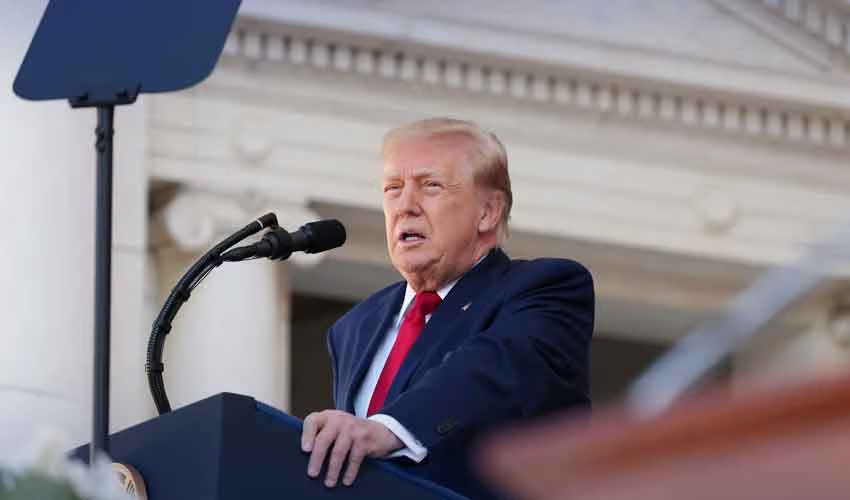
US President Donald Trump has informed senior advisers in recent days that he may refrain from launching further attacks on Iran, provided Tehran or Iran-backed Houthi forces in Yemen do not carry out any fresh provocations, according to three people familiar with the discussions.
Trump has repeatedly shifted between threatening to intensify the conflict through additional strikes and signalling a willingness to bring hostilities to an end. However, current and former officials say he has yet to settle on a clear strategy for ending the unpopular war, which he launched alongside Israel in February.
During meetings with national security advisers and following several intelligence briefings, Trump reportedly said he was considering suspending further military strikes, according to the sources, who spoke anonymously, as did others interviewed for this report.
He has also shown understanding towards regional allies who have urged him to avoid returning to a full-scale conflict.
“I could end it immediately, but at the request of the nations that I am looking to protect, we are doing it a little bit longer way, a bit more civilly,” Trump told sports broadcaster Stephen A. Smith on Thursday.
The conflict has driven up fuel prices worldwide and become increasingly unpopular among American voters, who handed control of Congress to the Democrats in last week’s midterm elections. A Reuters/Ipsos survey conducted shortly before the November 3 polls found that 55% of Americans believed the war was not worth its cost. Vice President JD Vance also blamed the conflict for the Republicans’ loss of control of Congress.
Trump’s private remarks are consistent with his recent public statements, in which he has sought to downplay the possibility of a renewed large-scale military campaign.
“As Commander-in-Chief, President Trump is the architect and sole decision-maker who holds all the cards and will always ensure that America’s interests are protected,” a White House official said in a statement. “The United States is in a very strong position with control of the Strait of Hormuz and the Iranian economy collapsing. Only President Trump knows what he will do, and when.”
The CIA and the Office of the Director of National Intelligence did not respond to requests for comment.
Discussions with Saudi Arabia and Turkey
During phone conversations over the past fortnight, Trump sought the views of Saudi Crown Prince Mohammed bin Salman and Turkish President Tayyip Erdogan. Both leaders reportedly advised him against launching fresh attacks on Iran, according to a senior US official and another person familiar with the discussions. The sources said Trump did not commit to either course of action.
According to two other people familiar with the conversation, Trump told bin Salman on October 31 that he intended to launch an attack after the elections. However, the Saudi crown prince urged him to reconsider, arguing that economic sanctions were already putting pressure on Iran.
Saudi Arabia’s Foreign Ministry did not respond to a request for comment.
Turkey’s presidency said Trump had held three telephone conversations with Erdogan since October 28. An official statement following their November 7 discussion emphasised the need to bring an end to tensions between Iran and the United States.
US intelligence agencies believe the American naval blockade and economic sanctions are damaging Iran’s economy and will continue to increase pressure on Tehran, according to two US officials who had been briefed on the intelligence assessments.
In addition to its months-long blockade of Iranian maritime traffic, the US military is also working to stop weapons and other sanctioned goods from entering Iran through land routes or via the Caspian Sea, Reuters reported for the first time last week.
Military Strategies
Meanwhile, three additional sources familiar with US military planning said American forces remain prepared to intensify operations if the situation requires it.
According to the sources, a third aircraft carrier is expected to arrive in the Middle East within the next few days to take the place of one of the two carriers already deployed in the region. However, all three vessels could remain in the area if necessary.
One person familiar with Trump’s discussions with the Saudi and Turkish leaders said the US president could consider targeting Iran’s underground nuclear facilities. However, Washington has already attacked these sites, and it remains uncertain whether another round of strikes would achieve the desired results.
Two US officials said intelligence assessments indicate that renewed military attacks would be unlikely to significantly alter Iran’s position in negotiations.
Trump was also briefed about US weapons reserves, with some stockpiles reportedly having fallen to concerning levels, according to two people familiar with the intelligence briefings. Reuters reported in August that the US had expended “virtually all” of its long-range precision munitions, while another source briefed on the issue said those supplies have yet to be replenished.
“The United States Military has enough munitions and ammo to serve all of the commander-in-chief’s strategic goals and beyond,” the White House official said.
Pressure from Israel
According to a US official, Israeli representatives have continued urging the Trump administration to launch another military operation against Iran.
Trump indicated this week that Washington had already gained all it could through negotiations, although he stopped short of clarifying whether further military strikes would be launched.
“We don’t need a deal with Iran,” Trump said in a social media post on Thursday. “We’ve got their money, Hundreds of Billions of Dollars, and we’ve got their Strait!”
Meanwhile, US Secretary of State Marco Rubio has also argued that there is no need for additional American military action against Iran. He said economic sanctions have significantly weakened the Islamic Republic, while Washington’s primary goal remains preventing Tehran from developing nuclear weapons.
Addressing an event organised by the Federalist Society on Friday, Rubio said the economic consequences of US pressure had been so severe that further military operations were not necessary at this stage. His comments were in line with President Donald Trump’s earlier assessment that the war was “militarily effectively over”.
Rubio portrayed Iran as a country whose strength had been substantially diminished, adding that the economic pressure on its government had reduced the need for further military intervention.
“And right now, frankly, the economic pain that we are inflicting on that regime is so great that there’s no need for military action because we’ve weakened them so much,” Rubio said.
He emphasised that the ultimate indicator of success would be ensuring that Iran never obtains a nuclear weapon.
The US secretary of state also recognised the financial burden the conflict has placed on American citizens, particularly through rising fuel costs and disruptions affecting almost every sector of the global economy.





