






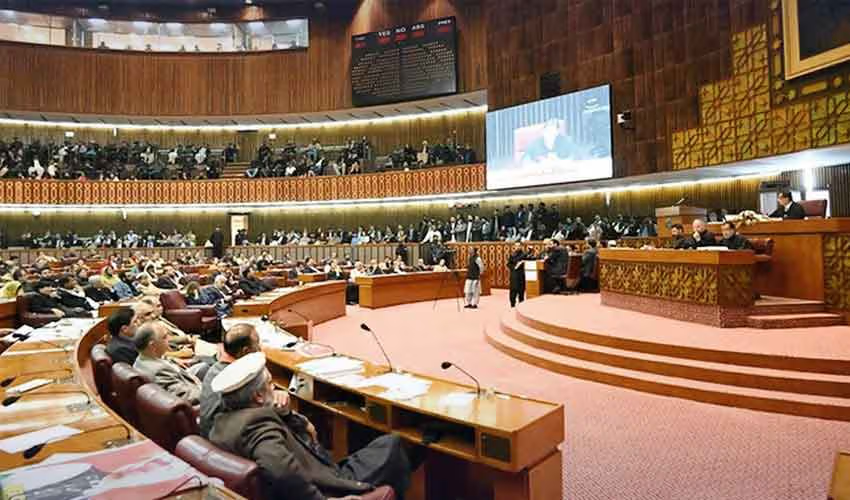
Parliament has approved the imposition of a state of emergency and Governor’s Rule in Khyber Pakhtunkhwa (KP), with both resolutions securing majority support during a joint session presided over by National Assembly Speaker Ayaz Sadiq.
Deputy Prime Minister and Foreign Minister Ishaq Dar defended the government’s decision, maintaining that all constitutional procedures had been followed. Federal Minister for Parliamentary Affairs Tariq Fazal Chaudhry said the measures were introduced after extensive discussions in view of terrorism and the KP government’s lack of cooperation.
The resolutions seeking parliamentary approval for the emergency and Governor’s Rule were moved during the joint session by Federal Minister for Parliamentary Affairs Dr Tariq Fazal Chaudhry.
Both resolutions were adopted by a majority vote. Dar explained that the National Assembly and Senate had passed the motions a day earlier under Article 232 of the Constitution, after which the matter was presented to the joint sitting for final ratification.
“The action taken in Khyber Pakhtunkhwa is in line with the Constitution,” Dar said, reiterating that the emergency and Governor’s Rule had been enforced in accordance with constitutional requirements.
He cautioned against interpreting Article 232 according to personal interests or political convenience, asserting that the government had met all the conditions specified under the provision. He also cited Article 234, stating that its requirements were unambiguous and had been implemented accordingly.
Dar further noted that Interior Minister Mohsin Naqvi had already provided Parliament with a detailed explanation of the prevailing situation.
Dar Urges Action Against Terrorism Beyond Political Differences
Speaking during the joint session, Dar described terrorism as a major challenge facing the country and urged political parties to place national security above their political differences.
“If we succeed against terrorism, other issues will also be resolved,” he said, noting that Pakistan had suffered significant losses in its prolonged battle against militancy and continued to bear the consequences.
“How many more times will we allow our citizens to be martyred for the sake of our own politics?” Dar questioned. He warned that if Pakistan did not confront terrorism effectively at this stage, it remained uncertain when the country would be able to overcome the threat.
Dar said the government had called an All Parties Conference (APC) to deliberate on the security situation. Representatives of all political parties, including the Pakistan Tehreek-e-Insaf (PTI), had attended the conference.
He stated that the APC had resulted in the joint formulation of a National Action Plan, which led to the launch of military operations Zarb-e-Azb and Radd-ul-Fasaad. According to Dar, these operations compelled terrorists to escape across the border.
He also raised questions about who had enabled militants to establish a presence in Pakistan and who had approved the return of Tehreek-e-Taliban Pakistan (TTP) members to the country.
Return of 40,000 to 45,000 TTP Militants to Pakistan
Dar alleged that approval had been given for 40,000 to 45,000 TTP members to return to Pakistan, maintaining that such decisions had played a role in the renewed wave of terrorism. He said those behind what he termed misguided decisions should be held responsible for their outcomes.
The deputy prime minister also discussed attempts to resume dialogue with militants, noting that Maulana Fazlur Rehman had proposed making another effort to pursue negotiations.
Dar said Prime Minister Shehbaz Sharif had informed Fazlur Rehman that the situation had gone beyond that stage. He added that the prime minister had also briefed him on the matter being taken up with the federal cabinet.
According to Dar, there had been reluctance to use the term “TTP” even in the relevant context, while Afghanistan’s interim government also avoided using the same terminology.
He further alleged that operations linked to the TTP were being conducted by the Balochistan Liberation Army (BLA) and other groups. Dar maintained that Pakistan had evidence relating to terrorist activities and had already shared it with international organisations.
Dar Urges Political Leaders to Respect the Constitution
Responding to criticism of the government’s constitutional measures, Dar stated, “No one should lecture us; we have always upheld the Constitution.”
He repeated that both the Senate and the National Assembly had endorsed the imposition of the state of emergency and Governor’s Rule, asserting that the measures taken in Khyber Pakhtunkhwa were consistent with the Constitution.
The deputy prime minister maintained that the government had fulfilled the conditions outlined in Articles 232 and 234, dismissing arguments that these constitutional provisions were being applied selectively.
During the session, Dar also spoke about meetings between former prime minister Imran Khan and his wife, Bushra Bibi, stating that she had been meeting the PTI founder on a regular basis.
Tariq Fazal Chaudhry Says Decision Was Made After Careful Consideration
Federal Minister for Parliamentary Affairs Tariq Fazal Chaudhry defended the imposition of the state of emergency and Governor’s Rule, emphasising that the decision should not be interpreted as a political win or loss for any party.
He explained that the government had reviewed terrorism-related statistics before reaching its decision and had been signalling for the past 10 to 15 days that emergency measures were under serious consideration.
Chaudhry attributed the decision to impose the emergency and Governor’s Rule to the lack of cooperation from the Khyber Pakhtunkhwa government.
Rejecting claims that the move had been made in haste, he said the government had held extensive discussions before proceeding with the measures.
The parliamentary proceedings represent a notable step in the federal government’s response to the political and security challenges in Khyber Pakhtunkhwa. The government maintains that the measures are constitutionally valid and necessary to tackle terrorism.





