


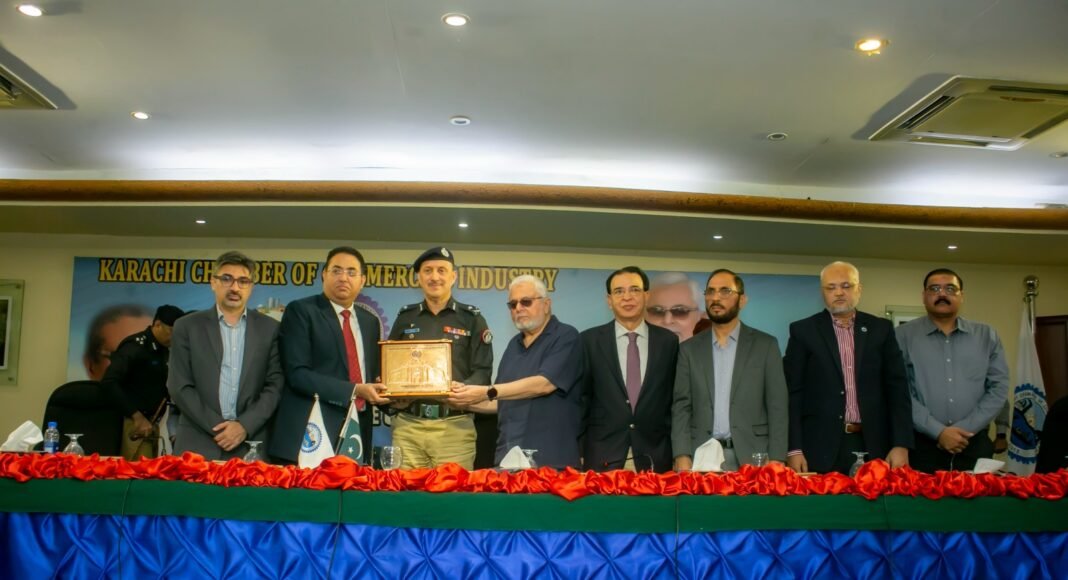
Chairman Businessmen Group Zubair Motiwala and President Karachi Chamber of Commerce and Industry Rehan Hanif presenting crest to Additional Inspector General of Police Karachi Azad Khan during his visit to KCCI on Tuesday. Vice Chairman BMG Anjum Nisar, President KCCI Rehan Hanif, Senior Vice President KCCI Muhammad Raza, Chairman Law & Order Subcommittee Akram Rana, Former SVP Zia ul Arfeen and Former VP Nasir Mehmood are also seen in the picture.
Additional Inspector General of Police (AIGP) Karachi Azad Khan, while assuring the business community that safeguarding Karachi, the country’s economic heart, is among the highest priorities of Sindh Police, emphasized that protecting the city’s commercial and industrial activities is synonymous with protecting Pakistan’s economy.
Stressing that terrorism, extortion and street crime remain the foremost challenges confronting law enforcement agencies, he said Karachi Police, in close coordination with intelligence agencies and other law enforcement institutions, has significantly strengthened preventive policing, resulting in a notable decline in major crimes, while reiterating an uncompromising policy against extortionists, land grabbers, narcotics networks and organized criminal groups.
He was speaking at a meeting during his visit to the Karachi Chamber of Commerce & Industry (KCCI) on Tuesday, which was also attended by DIG Traffic Pir Muhammad Shah, Chairman Businessmen Group Zubair Motiwala, Vice Chairman BMG Anjum Nisar, President KCCI Rehan Hanif, Senior Vice President KCCI Muhammad Raza, Vice President Arif Lakhani, Chairman Law & Order Subcommittee Akram Rana, Chief Police Chamber Liaison Committee PCLC Hafeez Aziz, KCCI Executive Committee Members along with Senior Police Officials were also present at the meeting.
Additional IGP Karachi Azad Khan stated that Karachi’s business district remains the top operational priority of Sindh Police because the city serves as the economic engine of Pakistan. “Every security measure undertaken in Karachi is not merely for this city but for the economic stability of the entire country”, he remarked, adding that the police fully recognize their responsibility to ensure a secure business environment that encourages economic activity and investment.
He informed participants that while 37 terrorism-related incidents had been recorded across Sindh during the corresponding period last year, only eight incidents had occurred during the current year, with no major terrorist incident reported. He credited this achievement to proactive intelligence gathering, preventive operations and close coordination among all law enforcement agencies.
Referring to street crime, the Additional IGP acknowledged that it continues to remain one of the biggest policing challenges. However, he shared encouraging statistics showing that overall street crime had declined by approximately 15 percent during the first six months of the current year compared to the same period last year.
He disclosed that incidents of robbery-cum-murder had declined by nearly 30 percent, cases involving injuries during robberies had reduced by 40 percent, while vehicle snatching had also declined by around 30 percent. Similarly, thefts of motorcycles and vehicles had registered a reduction of nearly 20 percent. Although mobile phone snatching had witnessed a slight increase, the overall trend reflected substantial improvement.
On the issue of extortion, the Additional IGP declared a policy of zero tolerance, describing extortion cases as one of the highest operational priorities of Karachi Police.
He revealed that during the first six months of the current year, nine extortionists were killed in police encounters, around fifteen were injured and sixty-one extortionists were arrested.
Referring to illegal foreign nationals, particularly undocumented Afghan nationals, Azad Khan said the federal government’s policy was being implemented rigorously and urged businesses and citizens not to provide employment or shelter to illegal immigrants.
Highlighting the impact of recently introduced technology-based traffic reforms, DIG Traffic Pir Muhammad Shah stated that the new traffic management system had already produced measurable results. Heavy vehicle accident fatalities had declined by 40 percent, while the overall system had prevented approximately 60 fatalities and saved nearly 217 citizens from serious injuries or permanent disabilities.
He said the Traffic Police had also initiated Karachi’s first comprehensive scientific study on traffic congestion to measure travel times across major corridors during peak hours. The findings would help formulate long-term engineering and traffic management solutions.
Chairman BMG Zubair Motiwala stated that while discussions on citywide law and order were important, the foremost priority should be the issues being faced by traders operating in Karachi’s traditional commercial markets, including Jodia Bazaar, the Cloth Market and other wholesale trading hubs. These markets, he said, encounter persistent challenges relating to security, encroachments, traffic congestion and administrative actions, which directly affect business operations.
Referring to anti-encroachment drives, Zubair Motiwala pointed out that legitimate shopkeepers often suffer unnecessarily while illegal roadside vendors continue operating. He stressed that enforcement actions must be fair and transparent so that genuine businesses are protected rather than penalized.
He suggested that Karachi Police designate dedicated focal persons to maintain regular liaison with market associations so that routine operational and security issues could be resolved promptly through continuous coordination with the trading community.
He also proposed introduction of an online FIR registration system, stating that technological reforms successfully implemented in traffic management should now be extended to criminal complaint registration.
Vice Chairman BMG Anjum Nisar lauded the Karachi Police for maintaining continuous engagement with the business community, observing that meaningful dialogue between law enforcement agencies and stakeholders was essential for creating an environment conducive to economic growth and investment.
President KCCI Muhammad Rehan Hanif, while referring to Karachi’s overall security environment, acknowledged that law and order had improved considerably compared to four or five years ago, crediting Sindh Police for playing a vital role in restoring peace. However, he cautioned that the situation was still far from ideal, particularly due to the recent increase in street crime incidents.
He urged the police leadership to formulate a more aggressive and effective strategy against street criminals, emphasizing that seemingly minor incidents of mobile phone or cash snatching frequently result in the tragic loss of innocent lives.
Describing the Safe City Project as one of the most critical initiatives for Karachi, President KCCI stressed that expansion of camera surveillance across the entire metropolis would substantially strengthen crime prevention, improve investigations and enhance public confidence.