


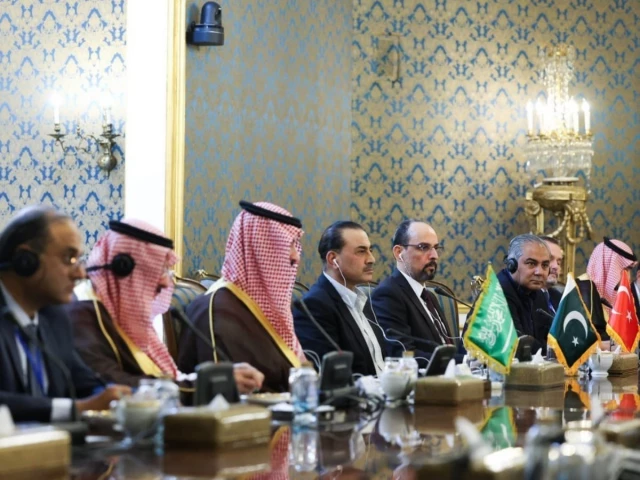
Senior officials from Iran and the three countries associated with the Makkah defence pact — Pakistan, Saudi Arabia and Turkiye — gathered in Tehran on Monday for high-level discussions on regional security challenges. According to Iran’s Press TV, the meeting focused on escalating regional tensions, the consequences of the US-Israeli military operations against Iran, and the latest developments in Palestine and Lebanon.
Major General Mohsen Rezaei, Secretary of Iran’s Supreme National Security Council (SNSC), received senior representatives from Pakistan, Saudi Arabia and Turkiye as the discussions commenced.
“The talks will focus on regional security, the fallout from military aggression, and support for Palestine and Lebanon,” Iranian media reported.
Pakistan’s delegation includes Chief of Defence Forces and Chief of Army Staff Field Marshal Asim Munir, along with Interior Minister Mohsin Naqvi. Saudi Arabia is represented by Defence Minister Prince Khalid bin Salman, while Turkish intelligence chief Ibrahim Kalin is also attending the high-level meeting.
Attacks carried out by Yemen’s Houthi movement have intensified significantly in recent weeks, while tensions between Washington and Tehran have continued to rise amid increasingly confrontational statements from both sides. Reports suggest that the United States and Iran have also developed plans for a possible resumption of the broader conflict, potentially following the US midterm elections scheduled for November 3.
The talks scheduled for Monday represent the first senior-level engagement between Iran and all three members of the defence alliance since Saudi Arabia became more deeply involved in the ongoing conflict. Under the Makkah Joint Defence Agreement, signed in August, any armed assault against one member state is treated as an attack on all participating countries.
Iranian Foreign Ministry spokesperson Esmaeil Baghaei stated that the discussions would address several pressing regional security concerns, including “Israel’s expansionist policies, developments in the Palestinian territories and Lebanon, and the repercussions of US and Israeli military action against Iran.”
Baghaei stated that the proposed meeting, which was discussed during Munir’s visit to Tehran last week, could serve as an initial move towards developing regional security arrangements that prioritise the shared interests of countries in the region.
Meanwhile, Qatari mediators held discussions with Iranian officials in Tehran on Sunday as part of renewed diplomatic efforts to ease escalating regional tensions, according to Reuters. Qatar has been actively involved in facilitating communication between Tehran and Washington for several months.
A senior Iranian official revealed that Pakistan had taken the initiative to arrange the meeting during Chief of Defence Forces (CDF) Munir’s recent visit to Tehran. During his trip, Munir met Iranian President Masoud Pezeshkian and other high-ranking officials. Iranian media reported that Tehran’s representatives made it clear during these discussions that negotiations with Washington would not resume unless Iran’s demands were fulfilled.
Previous diplomatic initiatives involving Pakistan and Qatar had contributed to securing a temporary peace agreement in June. However, the arrangement proved short-lived, collapsing within weeks as hostilities between Iran and the United States erupted again.
Ali Baqeri-Kani, deputy secretary of Iran’s leading national security body, informed state television that Saudi Defence Minister Prince Khalid, Pakistan’s Munir and Turkish intelligence chief Ibrahim Kalin were expected to travel to Tehran for high-level consultations with Iran’s Supreme National Security Council concerning regional security matters.
Saudi Arabia’s Deputy Minister for Public Diplomacy, Rayed Krimly, stated that the meeting forms part of continued diplomatic initiatives by the Makkah Pact member countries aimed at reducing tensions in the ongoing crisis, encouraging peaceful resolutions and strengthening mediation efforts undertaken by Qatar and Pakistan.
Highlighting the importance of regional cooperation and the alliance’s contribution to maintaining peace, Krimly wrote on X:
“The visit also underscores the pivotal role of the Makkah Pact states in fostering regional security and stability, and their commitment to working with all nations in the region toward achieving this goal.”
The Inter-Services Public Relations (ISPR) confirmed that the Chief of Defence Forces (CDF), Munir, is visiting Tehran today as part of an official trip.
Escalating Tensions
Saudi Arabia reportedly intercepted a fresh barrage of missiles and drones on Sunday as hostilities with Yemen’s Houthi movement continued without any indication of easing.
Earlier this month, ministers representing the Makkah Pact member states convened an emergency meeting in Riyadh, where they reached an agreement to facilitate the “rapid deployment” of military personnel and defence capabilities to Saudi Arabia.
The continuing Houthi attacks have further complicated the broader US-Israeli confrontation with Iran, placing Saudi Arabia, a key American ally, under increasing pressure and contributing to instability across the region.
Meanwhile, relations between Washington and Tehran have deteriorated further in recent days. On Friday, US President Donald Trump indicated that Washington could launch another military operation against Iran. Iranian leaders, in response, warned that any renewed American offensive would face a more forceful retaliation than previous attacks.
Iranian security officials have informed Reuters that Tehran has prepared detailed contingency plans to target undersea communication cables in the Gulf if the United States and Israel carry out additional strikes. At the same time, a US intelligence memorandum issued this week cautioned that alleged Iranian plans targeting American personnel had reached “advanced stages”.
The conflict, which has now continued for nearly eight months, has also affected President Donald Trump’s approval ratings as the United States approaches its midterm elections.
According to the agreement text reviewed by Reuters, the first article of the Makkah defence pact requires participating countries to employ “all necessary means” to counter threats against one another’s territorial integrity, national sovereignty and internationally recognised borders.
Meanwhile, Turkey’s parliament began the process of ratifying the agreement last week, with deliberations still ongoing. Pakistan, on the other hand, formally approved the pact last week.