






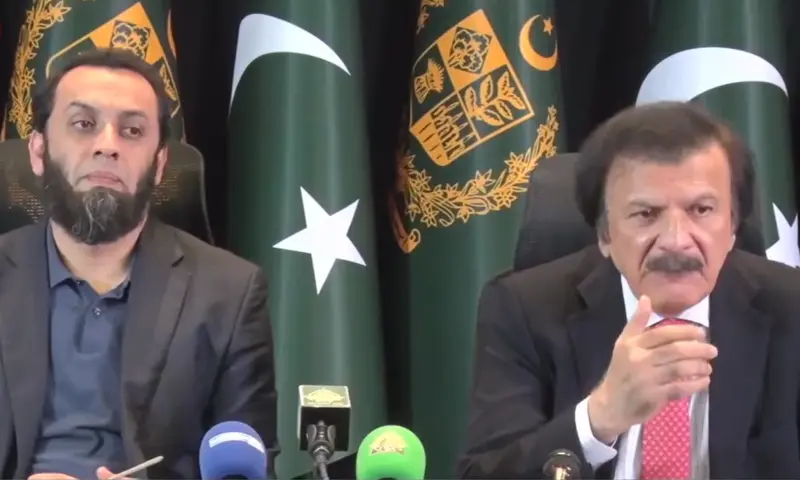
The federal government on Saturday unveiled its new automobile policy, placing particular emphasis on affordable vehicles and electric vehicles (EVs).
Information Minister Attaullah Tarar and Prime Minister’s Adviser on Industries and Production Haroon Akhtar Khan announced the policy during a press conference in Islamabad.
Addressing the media, Akhtar said extensive efforts had gone into preparing the policy, noting that Prime Minister Shehbaz Sharif had devoted considerable time to the process. He added that the cabinet approval process had started on Saturday, while Tarar explained that the government wanted to clear up speculation before proceeding with the approval.
Akhtar outlined six key pillars of the policy: making vehicles more affordable, particularly for the middle and lower-middle classes; boosting exports; increasing localisation; improving vehicle safety; promoting electric vehicles; and ensuring transparency.
He further said the prime minister had introduced a tariff policy aimed at reducing production costs and lowering the import bill for raw materials.

“You will see that prices of cars will come down … the manufacturing cost of automakers will come down; these were the prime minister’s specific instructions. The prices of all vehicles, except luxury vehicles, will come down,” Akhtar said.
He said vehicle prices would decrease in phases as duties on completely built units (CBUs), assembly plants and components were lowered annually. The process would continue over five years, eventually resulting in competitive tariff rates.
The prime minister’s adviser on industries and production said manufacturers would be required to meet localisation targets. He also announced a “rewards and penalty” mechanism to encourage exports. Under this system, exporters would receive a 5 per cent Duty Drawback on Local Taxes and Levies (DLTL), with an additional 10pc incentive as their exports increased.
“But if you do not achieve the targets, a penalty will be imposed as well,” he warned, explaining that car manufacturers would only qualify for DLTL after meeting both their complete export targets and domestic manufacturing targets.
Akhtar emphasised that the government had linked export rebates to the achievement of domestic manufacturing targets. He said Prime Minister Shehbaz Sharif wanted to generate more employment opportunities in Pakistan by encouraging the establishment of additional manufacturing plants.
Regarding vehicle safety, Akhtar said the new policy incorporates 45 further safety standards aligned with the United Nations’ WP.29 code. He stated, “When our vehicles will go through these safety codes, they will be considered the world’s safest vehicles — both manufactured and used.”
The adviser on industries and production also revealed that Pakistan’s target of converting 30pc of all newly purchased vehicles to electric power by 2030 was “about to happen sooner than that”.
Highlighting a “major benefit” for electric vehicles, he said the government had proposed three sales tax rates: 1pc for fully electric vehicles, 6pc for range-extended electric vehicles (REEVs) and 9pc for hybrid EVs. However, he clarified that the proposed rates would require approval from the International Monetary Fund (IMF).
Akhtar further announced that electric vehicles costing up to $50,000 would be exempt from capital value tax (CVT), withholding tax, and federal excise duty (FED). Vehicles exceeding this price threshold would fall into the “luxury” category and face standard taxation.
He added that the State Bank of Pakistan’s vehicle financing scheme, which currently provides loans of up to Rs3 million for conventional cars, would be extended to cover all EVs with financing of up to Rs10 million. The repayment period would also be increased from three to five years.
Akhtar further stated that the government would introduce incentives to encourage the establishment of electric vehicle charging stations. He described this as an important measure towards the long-term objective of transitioning to fully electric vehicles, with hybrid and range-extended electric vehicles (REEVs) serving as transitional options.
He explained that the government would cover the existing viability gap, as businesses were reluctant to invest in charging stations due to insufficient demand, while consumers needed adequate charging infrastructure before making the switch to EVs.
The sales tax on charging station equipment has been lowered to 1pc, while customs duty has been abolished.
Akhtar said that, given Pakistan’s commitment to the International Monetary Fund (IMF) programme, the government was seeking to maintain “neutral revenue on whatever incentives we are giving”. He explained that revenue would instead be generated through internal combustion engine vehicles (ICEVs) with engines above 1,000cc, while cars below 1,000cc, commonly used by lower- and middle-income groups, would remain exempt.
He added that the funds collected through this measure would also support export rebates and research and development initiatives.
Referring to the New Energy Vehicle (NEV) Policy 2025-30, introduced last year, Akhtar said sales of electric two-wheelers had risen to 240,000 in FY25-26, compared with 60,000 in FY2024-25.
‘A necessity of the hour’
During the press conference, Information Minister Attaullah Tarar expressed regret that decades of “protectionist policies”, which involved raising import duties and providing support to domestic industries, had failed to encourage local manufacturers to innovate or add value to their products.
Tarar highlighted the growing adoption of electric motorcycles and scooties, describing the trend as a “need of the time”. He also stressed the importance of curbing or reducing the country’s rising oil import bill, which directly affects the public through higher fuel prices.
He clarified that the new policy does not introduce any changes for conventional petrol-powered vehicles with engines below 1,000cc, as these remain widely used by ordinary citizens.
In a post shared on X, Tarar said the policy had been formulated following consultations with all relevant stakeholders, an assessment of technical data and an examination of different international models.
“Innovation, value addition, and localisation will be promoted in the local industry to create employment opportunities and enable vehicle exports,” he said.
The minister said promoting electric vehicles would help lower carbon emissions and reduce the country’s dependence on imported oil. He added that incentives had also been introduced to encourage investment in charging station infrastructure.
Tarar described the policy as a “significant step toward providing Pakistani citizens with affordable, high-quality, and environmentally friendly transportation”.





