






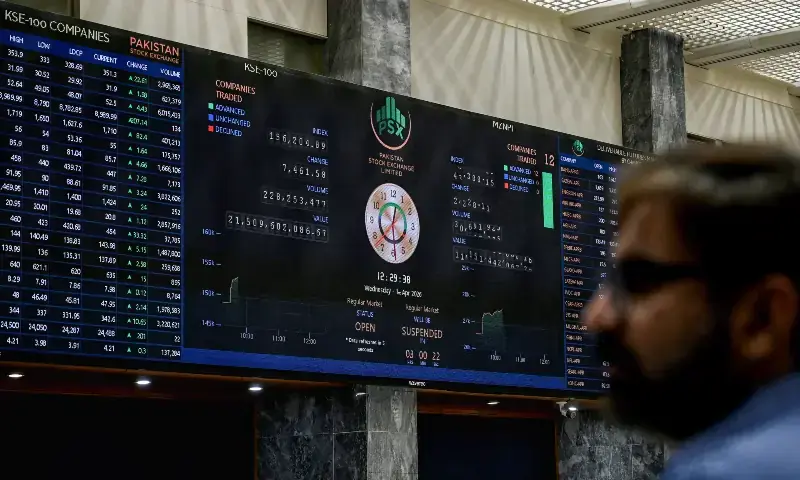
The Pakistan Stock Exchange (PSX) experienced fluctuations during the outgoing week as rising geopolitical uncertainty, persistently high global oil prices and increasing bond yields overshadowed positive sentiment surrounding Pakistan’s Staff-Level Agreement (SLA) with the International Monetary Fund (IMF).
Appearance
According to Arif Habib Ltd (AHL), the benchmark KSE-100 index declined by 0.6 per cent week-on-week, closing at 167,089 points after losing 1,066 points.
Investor sentiment remained weak amid attacks on major shipping routes, as Yemen’s Houthis broadened their targets to include civilian infrastructure and energy installations in Saudi Arabia. Meanwhile, Ukrainian drone attacks on Russian oil refineries and concerns about US energy supplies kept Brent crude prices above $100 per barrel, according to AKD Securities Ltd.
KSE-100 sheds 1,066 points during the week as Brent futures stay above $100 per barrel
Pakistan received some market support from the SLA covering the fourth review of the Extended Fund Facility (EFF) and the third review of the Resilience and Sustainability Facility (RSF). The agreement opens the way for the release of $1.2 billion under the two programmes, subject to approval from the IMF Executive Board. Once approved, cumulative disbursements under both facilities would rise to approximately $5.7 billion.
Nevertheless, worries about the expanding trade deficit, inflationary pressures and the likely direction of interest rates continued to dampen investor confidence.
AHL reported that the government secured Rs381 billion in its latest Pakistan Investment Bonds (PIBs) auction, exceeding the target of Rs350 billion. Cut-off yields increased by 26–41 basis points on three-, five- and 10-year bonds, whereas the yield on two-year bonds fell by 19 basis points. Offers for 15-year bonds were turned down. The increase in yields strengthened market expectations that the central bank could raise the policy rate at its next monetary policy announcement.
The State Bank of Pakistan’s foreign exchange reserves increased by $15 million to $21.5 billion as of October 2. Meanwhile, the Pakistani rupee recorded a slight appreciation of 0.03 per cent, closing at Rs277 against the US dollar.
Central government debt reached Rs82.95 trillion at the end of August, representing a 7.1 per cent increase compared with the same period last year, although it declined by 0.5 per cent from the previous month.
Among sectors, banking stocks exerted the greatest downward pressure on the benchmark index, contributing a loss of 566 points. Fertiliser companies followed with 234 points, while automobile assemblers shed 97 points, cement firms 75 points, and textile composite companies 43 points.
Habib Bank, MCB Bank and United Bank emerged as the biggest drags on the benchmark index, together accounting for a decline of 388 points. Fatima Fertiliser and Fauji Fertiliser Company also contributed to the downward pressure.
Oil marketing companies provided the strongest positive support, contributing 110 points, while power sector stocks added another 36 points. Pakistan State Oil was the leading individual contributor, adding 113 points to the index. Hub Power Company, Pakistan Oilfields, Engro Holdings and Mari Energies also helped limit market losses.
Trading activity slowed during the week, with average daily share volume declining 18.6pc week-on-week to 427 million shares. Meanwhile, the average daily traded value fell 2pc to $67 million.
Cement dispatches increased 6pc year-on-year to 4.62 million tonnes in September, driven by a 7pc rise in domestic sales, while exports remained unchanged. During the first quarter of FY27, total dispatches grew 4pc to 13.14 million tonnes. Local sales recorded an 8pc increase, offsetting the impact of an 11pc decline in exports.
According to AKD Securities, banking sector deposits expanded 14pc year-on-year to Rs39.2 trillion by the end of August. Cotton arrivals also recorded a 5pc increase, reaching 3.2 million bales during September.
Oil production dropped 6.4pc week-on-week to 63,700 barrels per day, while gas output decreased 1.4pc to 2,999 million cubic feet per day. The declines were primarily attributed to lower production from northern oilfields and the Mari, Sui and Sharf fields.
Petrol prices climbed 2.1pc to Rs398.96 per litre, whereas high-speed diesel became 0.9pc cheaper, falling to Rs395.72 per litre.
Separately, Sindh Engro Coal Mining Company is undertaking an expansion of its Thar Block-II mine to provide additional coal supplies to Lucky Electric Power Company. The initiative could allow the power producer to shift entirely to locally sourced coal, lowering its dependence on imported fuel.
Looking ahead, analysts believe upcoming quarterly earnings announcements and developments on the geopolitical front will play a key role in determining market direction. The benchmark index was trading at a price-to-earnings ratio of 7.5 times, with a dividend yield of 6.7pc.
Analysts added that declining inflationary pressure, improving economic indicators and a potential easing of tensions in the Middle East could bring oil prices down and improve prospects for monetary easing. However, continued geopolitical uncertainty may limit further market gains.





