






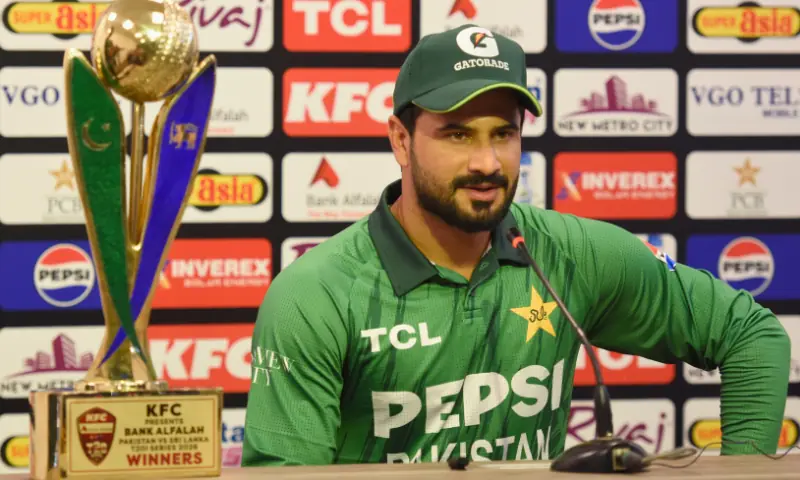
Sahibzada Farhan has started his stint as Pakistan’s T20I captain with a clear understanding of the challenge before him, aiming to shift the team away from relying heavily on star players and develop a more attacking and flexible side.
The three-match series against Sri Lanka, which gets underway under lights at Rawalpindi Cricket Stadium on Friday, will provide the first opportunity to assess this new approach.
Farhan, who guided Pakistan to a silver medal at the recent Asian Games and finished as the top run-scorer at the 2026 T20 World Cup with 383 runs, has taken over the captaincy from Salman Ali Agha. Meanwhile, Babar Azam and Shaheen Shah Afridi have been left out of the 15-player squad.
However, Farhan has played down the importance of his appointment as captain, instead focusing on areas he feels the team can directly influence: securing victories, embracing a quicker T20 approach and making the most of the players available to him.
“There is pressure… you are leading from the front,” Farhan told reporters on Thursday. “But it is not that we will let that pressure sit on our heads.”

He said his experience of playing domestic cricket and representing Pakistan at the Asian Games had given him the preparation needed for the responsibility. He also described the current squad as “a proper mix-up” of emerging players and experienced seniors returning to the side, including Fakhar Zaman and Shadab Khan.
Farhan suggested that Pakistan’s top-order batters would be backed to continue with the attacking style that has become a feature of his own batting. However, the Rawalpindi conditions could lead to a different team combination compared with the one used in Japan, with the side likely to field two spinners and three fast bowlers.
Farhan’s statistics reflect his preference for an aggressive, high-tempo style of T20 cricket. He has accumulated 1,305 runs from 46 T20Is at an average of around 30 and a strike rate close to 137, including two centuries.
One of those centuries came against Sri Lanka during the Super Eights stage of this year’s World Cup, where he combined with Fakhar Zaman to produce a tournament-record partnership of 176 runs.
His strong recent performances have also added weight to his credentials as captain. The squad around him features Saim Ayub, Hasan Nawaz — who struck 96 in the Asian Games final — Naseem Shah and Abrar Ahmed, along with several players with little or no international experience.
Farhan was keen to distinguish his leadership responsibilities from the selection process, making it clear that choosing the squad remained the committee’s job. His role, he said, was to utilise the 15 selected players as effectively as possible.
Pakistan’s recent T20 performances have been marked by inconsistency, along with repeated changes at the top of the batting order. This latest transition appears focused on building a versatile squad instead of relying on a fixed hierarchy.
“This is the Pakistan team; it doesn’t belong to anyone,” Farhan said when asked about the absence of Babar and Mohammad Rizwan. “Doors are open for everyone.”
Sri Lanka, meanwhile, will be led by Kusal Mendis following a 0-3 T20I series loss in England. Despite that setback, the captain believes his team can draw encouragement from aspects of their performance on the tour.
“In England we had a little bit bad series in T20, but we have more positive things in bowling and fielding,” Mendis said during his pre-series media interaction. “Different conditions compared to England and Pakistan. We planned so many things, and we tried so many new things.”
Mendis expressed confidence in the younger players within his squad, saying: “I know my players’ strength… they give 100 per cent every match. I have a very good trust in my players. No doubt in anybody.”
He pointed to bowling as Sri Lanka’s biggest strength but admitted that Pakistan’s fast-bowling attack would present “a very good challenge”. He also observed that the Rawalpindi pitch looked like “a little bit batting track”.
For Pakistan, the series is the final major T20 assignment before the team shifts its focus towards the ODI format and begins preparations for the next World Cup cycle. Farhan, however, remains focused on the immediate challenges rather than looking too far into the future.
This approach could also shape the wider philosophy of Pakistan’s new setup, with greater importance being placed on execution, flexibility and collective purpose instead of reputations and established credentials.
Whether this strategy can help Pakistan achieve the consistency they have lacked in recent times will ultimately be determined by their performances on the field. For now, though, the direction of the team under Farhan appears to be firmly established.





