






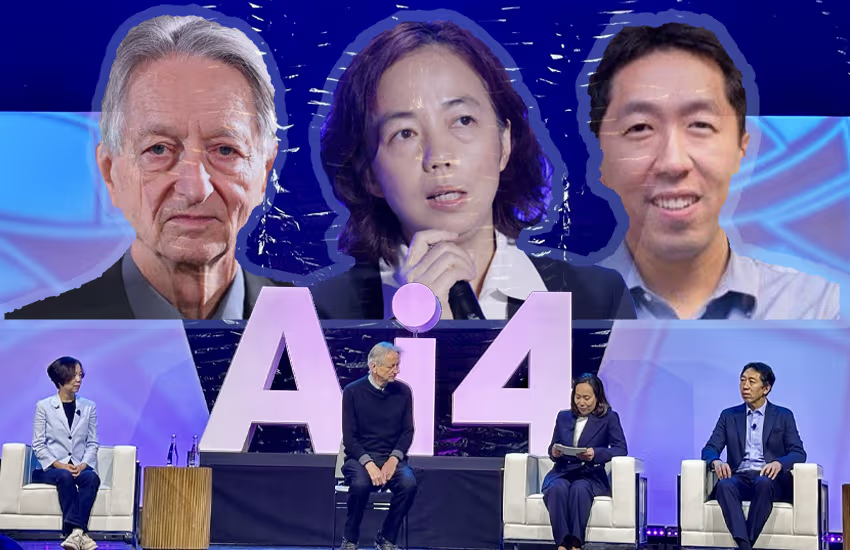
Four of the well-known artificial intelligence researchers said on Wednesday that in five to six years, artificial intelligence could really help the world say that illiteracy is gone. They said this during the day of the AI4 2026 conference. They think that people are scared of intelligence, and that is the biggest problem it causes for jobs right now, not that it replaces people.
The people on the panel were Geoffrey Hinton, who won a Nobel prize; Fei-Fei Li, who created ImageNet; and Andrew Ng, who founded DeepLearning. Yun-Hee Kim, who is a deputy editor at the Washington Post. They were asked what artificial intelligence news we might hear in the next five to six years.
Fei-Fei Li said, “I think that we have a chance to make an announcement in five years that artificial intelligence has helped the world get rid of illiteracy.” She is also the boss of World Labs. Helps run the Human-Centered AI Institute at Stanford.
Geoffrey Hinton said that artificial intelligence is already changing what people do at work, taking their jobs. He gave an example of a health service worker who used to spend a lot of time writing responses to complaints. Now an artificial intelligence system writes the draft, and she just has to review it and make corrections. This takes a lot of time, so she can focus on other things. Artificial intelligence is really helping people like her. It could be a big part of getting rid of illiteracy, which is what artificial intelligence researchers like Geoffrey Hinton and Fei-Fei Li are working towards.
Feeding Fears
The people on the panel said about 1.5% of jobs have been negatively affected by AI so far. This is much lower than the claims that say as many as half of all workers have already been changed by this technology. They said there has not been any disruption. They also said that jobs have actually become more secure, easier to get, and there are more of them since AI tools became available to everyone.
“Companies that are making AI have a reason to tell you two things ” Hinton said. “First, it will not work out well. Second, it will not cause a lot of job losses.”
Hinton said software engineering, a job that was expected to be hit the hardest by AI two years ago, has actually seen more demand for engineers. AI tools are handling the parts of writing code, and engineers are moving into creating and watching over AI systems. He said the same worries were talked about before for technical jobs, and each time they turned out to be wrong. He said the same thing is happening with coding
He said a similar change is happening in customer service centers. Talking to a person is easier now, not harder, Hinton said. AI is handling the parts of answering calls and emails. This lets workers focus on more important tasks. He said the main job of a customer service employee is becoming more about helping and encouraging customers, not just handling a lot of calls. AI has made this change possible, not stopped it.
Public Opinion & Legislation
Hinton also said fear of AI is affecting young people directly, beyond the labor market. He recounted a conversation with a high school student who told him she felt discouraged from writing because she could not match the fluency of an AI chatbot’s prose. He said the wider public narrative around job losses has made it harder, not easier, for governments to legislate on AI, since a frightened public tends to produce reactive policy rather than considered policy.
Support the Authors
On payment, Hinton said that authors and other creators whose work has helped train language models should get money for that data. He said the idea from AI companies that talking to millions of authors one by one is not possible is wrong.
“We have things called AI engines, and AI engines are very good at doing things like that,” he said. He said that AI systems could do the talking for companies reaching out to people who own the rights, getting permission, and setting a price, whether it is a one-time payment or money every time the work is used. “I don’t see any reason why we can’t have a system like that, “He added that laws should be made to support this idea.
Open Source & Closed Source
Li used part of her comments to challenge the way AI development is being seen as a choice between open source and closed proprietary models. She said this is a way to think about it. She compared the situation to physics. In that area, basic scientific research is done openly. The most important applications, like uranium enrichment, are kept under control. She said AI development will probably not end up in one type of model. Instead, it will fall into a range of openness.
She mentioned the mapping of the genome in the 1990s as an example. A private company and a group of universities were trying to finish the genome sequence. If the private company had won and kept the results secret, she said, the technology could have been kept away from the scientific and medical world. Both groups announced their work together. The government at the time made the data public. That data became the base for years of drug research that helped both private companies and public groups.
“This kind of discussion, especially when it says we can only have one type, is the way to think ” Li said. She said reporters who cover AI have a duty to move beyond that way of thinking. “We need to look at the details. We need to understand what the details are. We need to think about when and where and how to use types of openness or closed models,” she said.
Ng, who started DeepLearning.AI. Was once the head of Google Brain, joined Hinton and Li on the panel. The discussion during the panel focused on the idea that Silicon Valley has not done enough to explain the effects of AI to people. This failure, more than the impact of the technology, is causing the current fear about jobs.
Kim, who was leading the session, asked the panelists how quickly new types of jobs related to AI could appear. Hinton said he did not know how fast new roles would come. He said the more important problem was to fix the way people think about job losses. He said this would help make laws and education plans based on facts, not fear.
All four speakers agreed that AI has created jobs and will keep creating them. They also said that the fear about jobs is greater than the problems right now. None of them disagreed with the idea that AI systems will eventually do better than humans at tasks as more data and computing power are added. What they argued about was the time frame that people are being told, not the outcome. This difference, which was not fully discussed during the session, is likely to stay after the conference.
The speech was one of the events at the AI4 2026 conference. This conference has brought together technology leaders, government officials, and researchers. They have been talking about the future of AI development for the past five to 10 years.





