






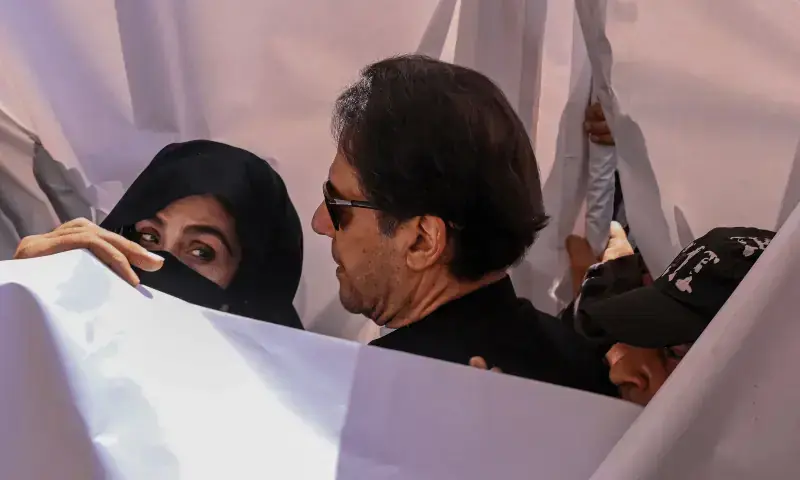
In the £190 million corruption case, lawyers representing PTI founder and former prime minister Imran Khan and his wife, Bushra Bibi, maintained that the transaction had not inflicted any financial loss on the national exchequer and had, in fact, generated financial benefits.
Imran Khan and Bushra Bibi are currently serving prison terms in the £190 million corruption case, commonly referred to as the Al-Qadir Trust case. On January 17, 2025, an accountability court in Islamabad handed Imran a 14-year prison sentence and Bushra a seven-year sentence. Both later filed appeals against their convictions before the Islamabad High Court (IHC).
The latest development came on Wednesday as the IHC resumed hearing the appeals filed by Imran and Bushra challenging their convictions.
The appeals were heard by a two-member bench comprising IHC Chief Justice Sardar Muhammad Sarfraz Dogar and Justice Muhammad Asif.
At the beginning of the hearing, Barrister Salman Safdar, representing the appellants, requested that the proceedings be live-streamed, noting that this facility was available in courts throughout Pakistan as well as in other countries.
He argued that the request was intended to promote transparency in a case involving issues of public importance. The lawyer clarified that he was not asking for the proceedings to be broadcast on Pakistan Television, but wanted them streamed live so the public could follow the hearing.
Barrister Safdar highlighted that the trial had taken place behind closed doors at Adiala jail. He argued that conducting open proceedings and allowing live streaming at the IHC would help overcome the restrictions on public access during the trial.
Justice Dogar remarked that arguments related to the May 9 incident and other general issues had no relevance to the current proceedings. He directed the counsel to concentrate on the pending application and the legal questions raised in the appeals.
The judge further noted that IHC hearings were already accessible to the public and that the courtroom was filled with people.
When Barrister Safdar pointed out that Imran was 74 years old and behind bars, the chief justice advised him to focus on legal submissions instead of making general remarks about the appellant.
The lawyer referred to the case of former military ruler General (retd) Pervez Musharraf and presented excerpts from Indian court rulings to support his request for live-streaming the proceedings.
However, Justice Dogar noted that the rules for live-streaming court proceedings had not yet been finalised, adding that the application could not be approved at this stage.
Barrister Safdar asked the court to defer the application until the relevant rules were introduced, expressing hope that the issue would be settled shortly. He said that, in his capacity as an advocate, he believed it was appropriate to present legal arguments even if the judge was initially unwilling to accept his request.
The chief justice remarked that decisions regarding the conduct of court proceedings rested with the court itself.
Turning to the main appeals, Barrister Safdar stated that the prosecution had presented 35 witnesses during the trial and that Imran had been convicted under different sections of the National Accountability Ordinance.
He explained that Imran was formally arrested in the case on November 13, 2023, whereas Bushra was found guilty of abetment and taken into custody following her conviction.
The lawyer noted that several people, including former accountability adviser Mirza Shahzad Akbar, property tycoon Malik Riaz, his son Ahmed Ali Riaz, Zulfikar Bukhari, Farhat Shahzadi and Ziaul Mustafa Nasim, had been declared absconders in the case.
Referring to the charge sheet, he said Akbar had presented a letter from the UK’s National Crime Agency (NCA) concerning the freezing of bank accounts owned by Riaz and his family.
He explained that the accounts were frozen in three separate stages, arguing that the alleged financial benefits provided to Imran and Bushra had taken place before the accounts were frozen.
He also referred to the prosecution’s claim that Bahria Town had allegedly provided financial benefits to Imran and Bushra through Bukhari in April 2019, presenting them as donations.
However, Safdar pointed out that Riaz’s funds were frozen on August 12, 2019. He added that Imran was initially accused of abetment but was later designated as the principal accused in the case.
Under the prosecution’s version, Imran allegedly authorised the transfer of the frozen funds to an account held by the Supreme Court, in violation of the Rules of Business. The money was connected to Rs460 billion that Riaz was required to pay in relation to the Bahria Town land dispute in Karachi.
Barrister Safdar argued that the funds had been transferred into the Supreme Court’s account even before the Federal Cabinet granted its approval.
He alleged that Akbar and Nasim, both declared absconders in the case, had helped place the relevant summary before the cabinet and facilitated the transfer of the funds.
The lawyer further stated that the prosecution believed the money should have been deposited with the State Bank of Pakistan (SBP), rather than the Supreme Court’s account, for the settlement of a civil liability.
Discussing the land deal involving Al-Qadir University, he said the property was transferred in January 2021. The prosecution alleged that Riaz had provided Rs285 million for the university’s construction and furniture. However, Safdar maintained that this money was never deposited into the personal accounts of Imran or Bushra.
He said Imran was accused of presiding over a cabinet meeting on December 3, 2019, and misleading its participants into approving the transfer in order to benefit Riaz.
The lawyer maintained that the money was deposited into the Supreme Court’s account and later invested in profitable projects, producing considerable financial returns.
“The amount remained with the Supreme Court for four years, and everyone knew about it,” he argued, adding that the funds had yielded significant profits.
Barrister Safdar also highlighted that Akbar had served in several capacities, including special assistant to the prime minister, chairman of the Assets Recovery Unit and adviser on accountability. He alleged that Akbar, working with others, had played a central role in signing the confidentiality agreement that enabled the recovery of the frozen funds.
He argued that no evidence showed Imran had direct knowledge of any alleged wrongdoing. He also maintained that neither Imran nor Bushra had signed the confidentiality agreement.
The lawyer questioned how Imran could have known about any alleged irregularities when the National Accountability Bureau (NAB) was itself part of the Assets Recovery Unit.
In response to Justice Dogar’s observation that the Assets Recovery Unit was an independent organisation, Barrister Safdar said it included representatives from NAB, the Federal Investigation Agency and the SBP.
“If these officials were unaware of any wrongdoing, how could Imran Khan have known about it?” he questioned.
Safdar maintained that the transaction had not caused any financial damage to the national exchequer, arguing that the money remained within the banking system and had nearly doubled in value through investments.
He insisted that the case could not be treated as a matter involving losses to the national exchequer, as the transaction had instead produced financial gains. He further argued that the expensive prosecution had itself placed an additional burden on taxpayers.
Challenging the prosecution’s claims of collusion, the lawyer pointed out that the trial had concluded despite several key suspects remaining absent and being declared absconders. He questioned how the alleged conspiracy and collusion could have been established under these circumstances.
Regarding Bushra, Barrister Safdar argued that she had no direct involvement in the transaction. He said neither the investigation nor the trial court’s verdict had clearly identified her specific role in the alleged offence.
He also argued that no evidence had established that the funds frozen in the United Kingdom were proceeds of crime. He maintained that if the money was illicit or derived from criminal activity, legal consequences could follow. Otherwise, its owner had the right to use it according to his own wishes.
The lawyer termed both the reference and the charge sheet unclear and vague, arguing that the prosecution had failed to prove the essential elements of the alleged offences against the appellants.
The court postponed further proceedings on the appeals until next week.





