






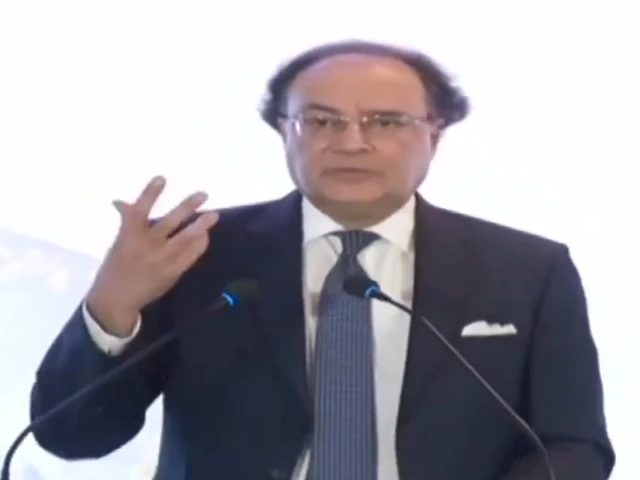
Finance Minister Muhammad Aurangzeb on Thursday called Pakistan’s minerals and mining industry a potential “game-changer” for the national economy, saying the sector could emerge as a major source of sustainable growth. He said the government was determined to break away from the repeated pattern of temporary, consumption-driven economic growth followed by balance of payments difficulties.
Speaking at the two-day Pakistan Minerals Investment Forum 2026 in Islamabad, Aurangzeb said the government was implementing major structural reforms and remained committed to continuing this process. He identified privatisation, public finance management, pension and tariff reforms, along with the shift towards a cashless economy, as key priorities.
The forum was attended by international investors and government representatives as Pakistan aimed to secure foreign investment in its mineral resources. Provincial leaders also presented investment prospects, incentives and development initiatives in the sector.
Aurangzeb highlighted the significant opportunities available in minerals and mining for attracting international investment and boosting sustainable exports. He said a single mining project was projected to bring in $2.8 billion in export earnings once it began commercial operations.
The finance minister admitted that the project had experienced delays but said its financing arrangements remained strong. He noted that it had obtained the largest syndicated financing facility in Pakistan’s history and that its financial partners continued to support the project as work progressed.
“When we talk about a game-changer, when we talk about a step change in terms of moving towards sustainable growth, minerals and mining is going to be one of the most important, if not the most important sector, which is going to take us towards sustainable growth,” he said.
Aurangzeb also pledged the Finance Ministry’s full cooperation in developing the minerals and mining industry. “We are there to help, support, and assist in any way we can, because Pakistan depends on this sector, and inshallah, as you will see and as you will hear, we will make it happen,” he stated.

The finance minister said Pakistan had repeatedly experienced a similar pattern in its economic history, where periods of economic stabilisation were followed by concerns over slow growth, eventually leading the country back towards consumption-driven expansion. “Whenever we get to a stabilisation phase, the question is, where is the growth? And that’s when we get into what I call the gold rush,” he added.
Aurangzeb said the economy had recovered from contraction several years ago and gradually returned to growth, recording 2% growth before reaching 3%. He added that growth in the previous fiscal year was marginally below 3.7%, while the government had set a 4% growth target for the ongoing fiscal year.
Warning against relying on liquidity-backed and consumption-based economic expansion, the finance minister said such an approach might produce immediate gains but would eventually lead to current account and balance of payments challenges. “We are very determined; we are not going to repeat that cycle. And therefore, it has to be sustainable growth,” he said, emphasising the need for an export-oriented growth model.
Discussing the measures introduced in the federal budget in June, Aurangzeb said the government had offered incentives to exporters and lowered taxes on the sector, although additional steps were still required. “We have brought down the financing rates, which are now between 4.5% and 6%,” he said.
He explained that exporters would continue to benefit from financing rates between 4.5% and 6%, regardless of the prevailing policy rate, which was currently 12%.
The finance minister also described tariff restructuring as an important part of the government’s economic reform agenda. He said the two relevant ministers were overseeing discussions on energy sector matters. “This time around, we are very focused on sustainable growth,” he said, highlighting the minerals and mining industry as a key contributor to this goal.
Aurangzeb further pointed to IT export services as another sector showing substantial progress. “From nowhere, to now going to be about $5 billion of IT export services during this fiscal year, inshallah,” he said, noting that the sector was strengthening Pakistan’s current account position and contributing to long-term economic growth.
Investment Environment and Privatisation Strategy
The finance minister said attracting foreign direct investment (FDI) depended on a series of economic and institutional requirements rather than occurring on its own. “People talk about FDI. Where is FDI?” he remarked, explaining that investment was driven by a “certain cascade” of conditions.
Referring to his previous experience in the banking sector, Aurangzeb said maintaining macroeconomic stability was the first essential step towards attracting foreign investment.
He noted that investors needed the freedom to transfer their capital into Pakistan and withdraw it when necessary, along with the ability to repatriate profits and dividends without having to negotiate with the State Bank of Pakistan or the Ministry of Finance.
Aurangzeb stressed that building confidence among local investors was equally important before approaching international investors.
“If the local investors are not showing their trust and confidence, it’s very difficult to convince some of you who have come from different regions and different parts of the world,” he stated, adding, “And that is where the PIA transaction and the PIA privatisation become so important.”
“There are 26 entities which were handed over to the Privatisation Commission,” he said, highlighting the privatisation of Pakistan International Airlines as a significant development, not only because of the transaction itself but also because of its impact on investor confidence. “One thing which is different from the last time around is making deep structural reforms and staying with those reforms,” he added.
Dar Says Pakistan Has Reached a Critical Economic Turning Point
Earlier at the forum, Deputy Prime Minister and Foreign Minister Ishaq Dar said Pakistan was at a crucial stage in its economic development, pointing to its vast mineral reserves and ongoing efforts to broaden its export portfolio. Welcoming the guests and more than 60 international delegates, Dar said the country aimed to utilise its geological and mineral resources to increase and diversify exports.
He identified Balochistan as a key region for Pakistan’s mineral sector, observing that the global shift towards clean energy was increasing demand for copper and opening up fresh prospects for mineral exploration.
Dar emphasised that economic progress must be accompanied by environmental safeguards, noting that the development of mineral resources had been made a strategic priority. He also highlighted the Pakistan Investment Policy 2023, which offers protection to investors, and outlined government initiatives to improve the country’s investment climate.
The deputy prime minister reiterated Pakistan’s commitment to respecting the sovereignty of all countries. He said the government was focusing on expanding international relations, while maintaining its strategic partnership with China as a major priority.
Dar further noted that provincial governments were also presenting investment prospects to attract international investors.

CM Maryam Says Punjab’s Mineral Revenue Surges Fourfold to Rs40 Billion
Punjab Chief Minister Maryam Nawaz said the provincial government’s revenue from the Mines and Minerals Department had climbed four times, rising from Rs10 billion to Rs40 billion over the last two and a half years.
Addressing the forum alongside the chief ministers of Sindh and Balochistan and the governor of Khyber-Pakhtunkhwa, she said Pakistan had vast mineral reserves that could be transformed into economic growth through exploration, investment and value addition.
“Pakistan holds immense potential, extraordinary wealth that waits to be discovered, that waits to be unearthed,” she said. “Pakistan is a pot of gold. And not only above the ground, but beneath the ground also.”
Maryam said Punjab had never lacked mineral resources, but administrative hurdles had previously stopped the province from making the most of its natural wealth.
She explained that when she took office, the Mines and Minerals Department was generating Rs10 billion in revenue, which had risen to Rs40 billion within two and a half years. “This is just the beginning,” she added.
The chief minister highlighted Punjab’s mineral reserves, including emeralds, marble, granite, gold, gemstones, copper, pink salt and rock salt. She also pointed out that Chiniot had an estimated 261.5 million tonnes of iron ore, which could be processed to produce steel.
Maryam also discussed initiatives to enhance the export value of pink salt, explaining that the mineral had traditionally been shipped abroad in its raw form, resulting in lower earnings for Pakistan.
She said the provincial government was offering interest-free loans to pink salt miners to promote value addition and encourage the production of processed and finished products.
Referring to potential placer gold deposits in Punjab’s riverbeds, particularly around Mianwali and Attock, she said surveys and research were being conducted to establish the available reserves. “We have significant evidence that there is sufficient quantity of placer gold,” she said.
Maryam further noted that sand and gravel found alongside placer gold deposits could also contain rare earth elements, valuable minerals and metals.
She said Punjab was looking to collaborate with international partners to explore these resources and turn them into economic opportunities that benefit all stakeholders.
On investment facilitation, the chief minister said the provincial government was taking steps to remove bureaucratic obstacles and introduce a one-window system for investors.
She added that investors were being offered land leases at reduced rates to lower their initial investment costs, while various schemes provided financing of up to Rs5 billion. “We are also offering concessional financing up to Rs5 billion. The component of interest is picked up by the government of Punjab,” she added.
The government was also supporting the installation of solar energy systems to help investors reduce their electricity expenses, she said.
Maryam further announced that investors in designated industrial estates, including the mineral processing zone in Quaidabad, Khushab, would receive exemptions or reimbursements on customs duties.
She said the Quaidabad mineral processing zone was offering land under a 15-year lease at a nominal monthly rental, with the option to extend the agreement.
Maryam also detailed financing schemes available to export-focused industries. These included interest-free loans of up to Rs100 million, financing with a 3% mark-up for amounts between Rs100 million and Rs3 billion, and loans carrying a 5% mark-up for investments ranging from Rs3 billion to Rs5 billion.
The chief minister said a separate financing fund worth Rs5 billion had been created to support value addition in the pink salt sector. Under the scheme, miners could obtain interest-free loans of up to Rs50 million, repayable over five years.
Calling the initiative a financially attractive opportunity, she pointed to an estimated return of 55%. She added that investment models and feasibility reports had been prepared for projects involving rock salt, iron ore, placer gold and construction materials.
Speaking about infrastructure, Maryam said Punjab’s extensive network of motorways, expressways, highways and roads connecting different districts was designed to support industrial expansion and mineral development.
She further said the government had shifted mining-related processes to digital platforms, including bidding, issuance of work orders, licence renewals, licensing, deposits and offer letters. “The bidding is online. The work orders are online. The renewals are online,” she said.
According to the chief minister, drone surveillance and digital systems were also being introduced to ensure greater transparency and make investment procedures easier.
She assured foreign investors that the provincial government would take all necessary steps to safeguard their physical security as well as their financial investments.
“We will make sure that they’re not only safe and sound and secure physically, but we will make sure that their investment is also safe, the returns are good, so that it’s a long-term partnership,” she said.
Maryam voiced optimism that Pakistan’s international image would improve and expressed hope that the country would take meaningful steps towards unlocking its mineral wealth.
Sindh CM Underscores Coal Projects and Lithium Reserves
Sindh Chief Minister Murad Ali Shah called on international investors and specialists to visit Pakistan’s provinces instead of restricting their engagements to Islamabad.
“I’d like to see not a year from now but hours and days from now, the global experts, the global investors to come to the provinces and not just stay in Islamabad,” he said.
He said the provincial government was assessing the potential of converting coal into fertiliser and gas, expressing hope that coal-to-fertiliser and coal-to-gas projects would be finalised within the coming year.
Murad also highlighted the potential lithium reserves in Sindh, revealing that he had recently held discussions on the subject with the chairman and managing director of the Oil and Gas Development Company.
He said the provincial government aimed to ensure that these reserves were properly explored over the next year, identifying lithium as another strategically important mineral.

Balochistan CM Unveils Plans for Oil, Gas and Digitalisation
Balochistan Chief Minister Sarfaraz Bugti said the provincial government was anticipating two major initiatives in the oil and gas sector, including the Saruna and Sui Fertiliser cities. He also emphasised the government’s intention to digitise the provincial minerals department by July next year.
Bugti said these initiatives were among the significant developments he hoped would be achieved before the next Pakistan Minerals Investment Forum.
K-P Governor Emphasises the Importance of Building Investor Confidence
K-P Governor Faisal Karim Kundi said the provincial government continued to prioritise strengthening the confidence of both domestic and foreign investors. He stressed the need to develop sustainable, long-term partnerships instead of focusing on securing immediate financial commitments.
Kundi hoped that by the time the forum was held again next year, investors would have greater trust in the K-P government and confidence in the province’s peace and stability. He added that progress on ongoing initiatives would reflect the provincial government’s commitment to creating a favourable environment for investors.
Earlier, while delivering his opening address, Petroleum Secretary Hameed Yaqoob Sheikh said Pakistan was at a crucial stage in advancing its mineral sector.
He noted that the country possessed significant reserves of copper, gold, chromite, coal, gemstones and other critical minerals, representing “unmatched potential and countless opportunities for investment”.
The petroleum secretary said the government had introduced key reforms to make the mineral sector more transparent, predictable and attractive to investors. He also pointed out that offshore exploration activities were getting underway with support from Turkiye.





